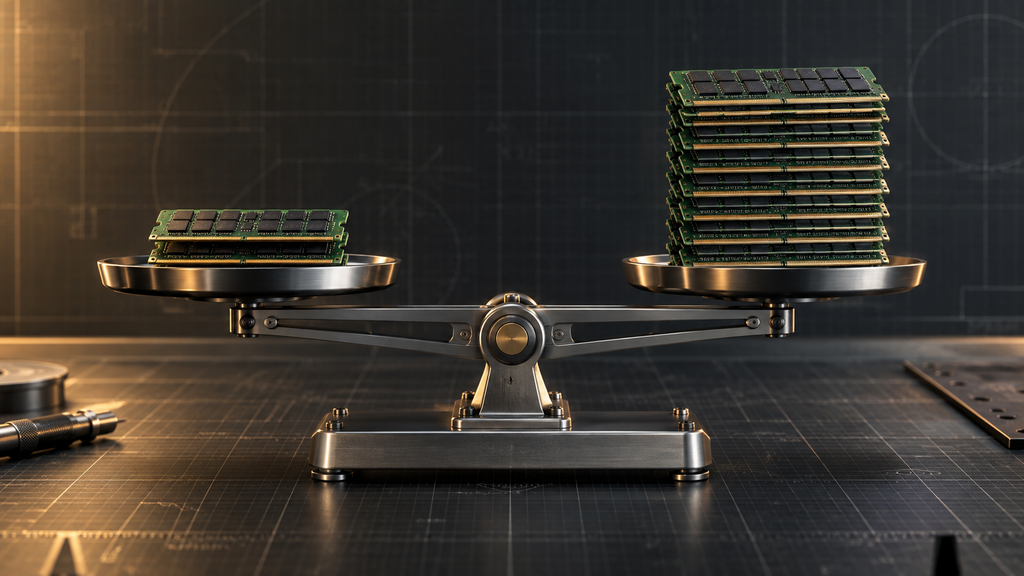
The folklore says fine-tuning is the rite of passage for serious local AI: point a model at your data, run a training job, and it becomes yours. The demand corpus tells a more conflicted story. One thread asks, verbatim: “$6k AMD AI Build (2x R9700, 64GB VRAM) - Worth it for a beginner learning fine-tuning” — a build in the same hardware class as our own lab, aimed at a beginner. ai.stackexchange keeps filling with model-training-size questions: given this card, how many parameters can I actually train? And one builder flexed the biggest number in the corpus and still hit the wall: “I built a server with 768GB VRAM for frontier, but all new frontier open source models are [too big to train].”
Three threads, one confusion. Inference VRAM and training VRAM are different budgets, and the gap between them is not a percentage — it is a multiplier. This article is the honest math.
One disclosure first: our lab has published no fine-tuning benchmarks. Every measured number we have comes from inference fleets; everything training-side here is arithmetic from first principles or ecosystem knowledge, and each claim is labeled as such. That is not a hedge — it is the difference between folklore and measurement.
First question: do you even need to fine-tune?
The 2026 answer is usually no.
Most requests that sound like fine-tuning are knowledge problems: “I want it to know my documents,” “I want it to answer from our wiki,” “I want it to speak about our product the way support does.” Fine-tuning is the wrong tool for knowledge injection. Weights are a poor place to store facts — training nudges behavior, it does not reliably file records, and anything baked into weights goes stale the day your documents change. The right tools are retrieval and context: a private RAG pipeline over your own knowledge base, long context windows, and disciplined prompting cover the large majority of these asks. We walk through that design in our guide to a private RAG knowledge base. If your goal is “the model knows my stuff,” start there, not with a training rig.
Model choice matters too. Much of what people hope to gain by fine-tuning, they already get by picking a model that matches the job — which is why we maintain a measured rundown of the best local LLMs of 2026.
What fine-tuning is genuinely for, in 2026, is narrower:
- Style and format transfer. You want a house voice, a strict JSON schema, a tone that prompting keeps drifting away from. A small adapter can lock behavior in.
- Domain adaptation. Jargon-dense fields — legal, clinical, specialized engineering — where the base model needs steering to use vocabulary the way practitioners do.
Both change behavior. Neither is a reliable way to store knowledge. If you cannot say which of the two you are doing, you are probably in the RAG case.
The VRAM math: inference versus training
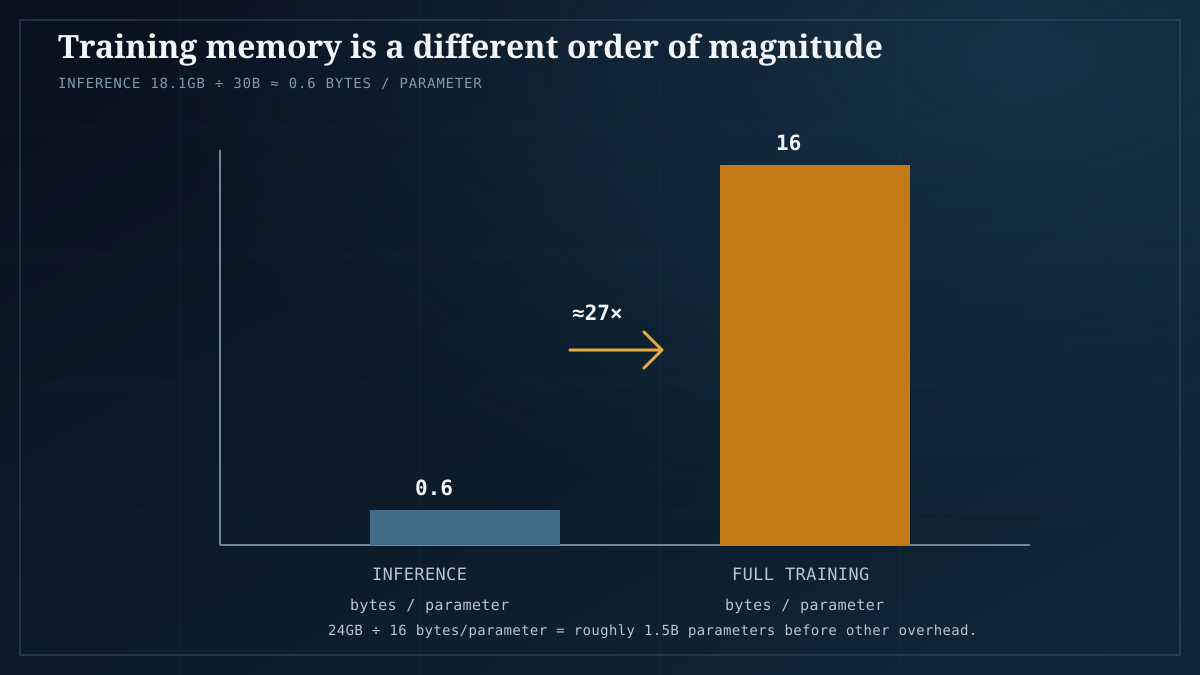
Inference is the cheap job. A quantized model at rest is mostly its weights plus a key-value cache for the conversation. That is why our measurements look the way they do: Qwen3-Coder-30B at Q4_K_M runs inference in 18.1GB (bm-003), and Qwen3.6-27B at Q4_K_M infers at 25.21 tok/s in an ~18GB-class footprint (bm-013). A 24GB card handles both with headroom.
Training is a different animal, because a training step must hold several things in memory at once:
- Weights, resident even when frozen.
- Gradients — one value per trained parameter, every step.
- Optimizer state — Adam-family optimizers keep two running statistics per trained parameter, typically in FP32.
The standard mixed-precision recipe — BF16 weights and gradients, an FP32 master copy, FP32 Adam states — works out to roughly 16 bytes per parameter. That is arithmetic, not measurement: 2 + 2 + 4 + 4 + 4. And it ignores activations, which add more on top.
Run the rule over the corpus:
- A 27B model, full fine-tune: 27B × 16 bytes ≈ 432GB, before activations. This is the deterministic answer to why a model that infers in ~18GB cannot train on a 24GB card. The inference footprint stores roughly 0.6 bytes per parameter; the training footprint stores sixteen. The same model needs about 24× more memory to train than to run.
- A 24GB card, full fine-tune: 24 ÷ 16 = 1.5B parameters. That is the entire budget — before activations, before the operating system’s claim.
- The 64GB dual-GPU build from the corpus thread: 64 ÷ 16 = 4B parameters for full fine-tuning. As a beginner’s training rig, the headline VRAM buys inference comfort, not training capacity.
- The 768GB server: 768 ÷ 16 = 48B parameters for full fine-tuning — which is exactly why that builder found frontier-scale open models “too big to train.” A 400B-parameter model needs on the order of 6.4TB under the same rule. 768GB is a superb inference budget and a training budget for a different decade.
These are first-principles numbers, labeled as such. Real runs vary with sequence length, batch size, and framework — but not by an order of magnitude. The multiplier is the point.
Where does quantization sit? Our quantization deep-dive lays out the footprint ladder for a 30B model: ~60GB at FP16, ~32GB at Q8, ~24GB at Q6, ~18GB at Q4. Quantization shrinks the weights rung of the training budget — and that crack is what QLoRA-class methods drive through. For inference-side planning more broadly, see our VRAM sizing guide.
QLoRA-class methods: the consumer answer
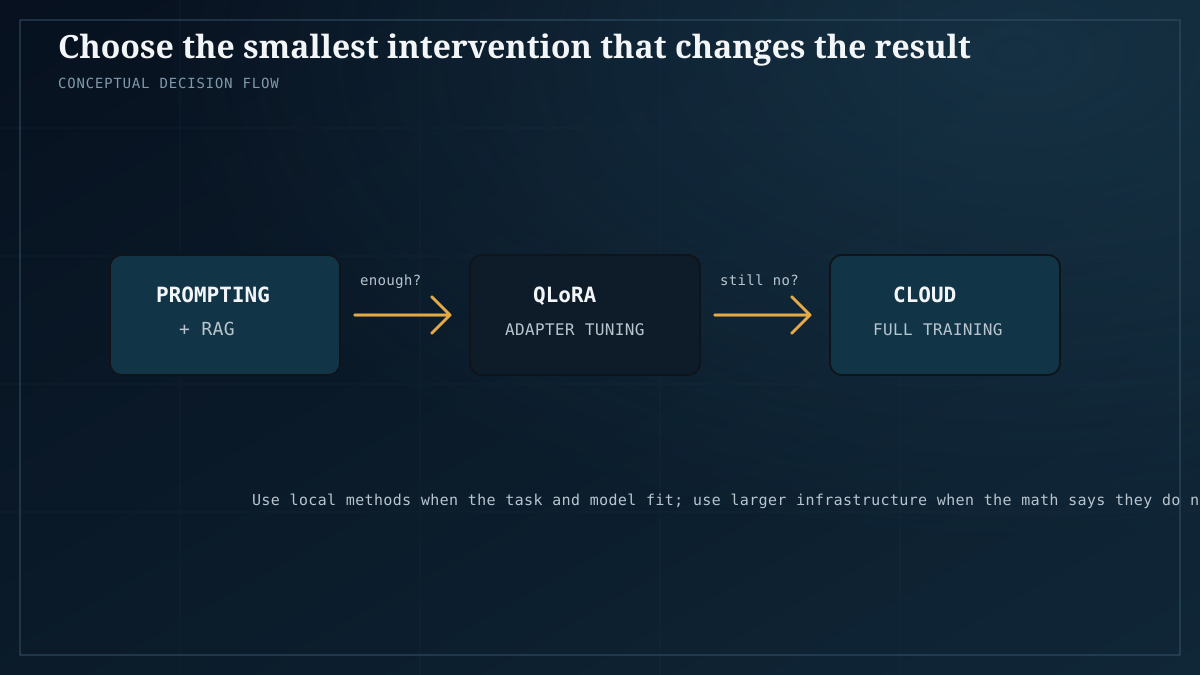
If full fine-tuning is out of reach, how do people train 27B-class models on desk hardware at all? The consumer answer is the QLoRA family of techniques. What follows is ecosystem knowledge, not our benchmark: freeze a 4-bit-quantized base model — the same quantization class we measure for inference — and train only small low-rank adapter matrices injected into a fraction of the layers. Because the adapters are tiny (often well under one percent of the base parameter count), gradients and optimizer state scale with the adapter, not the base. The 4-bit base of a 27B model sits in the same ~18GB-class footprint we measure for inference; the adapter’s optimizer state adds comparatively little, and activations fill the rest. That is how a 24GB card plausibly trains a 27B-class model — plausibly, per ecosystem practice, not per our measurements.
What it trades — also ecosystem knowledge:
- Throughput. Dequantizing on the fly makes training steps slower than FP16 training of the same model.
- Fidelity risk. A 4-bit base plus adapters is an approximation stack; quality deltas are task-dependent and must be evaluated per task — exactly the kind of measurement we have not done.
- Operational overhead. You now manage base-plus-adapter pairs, merge steps, and evaluation runs.
- The ceiling. QLoRA adapts behavior; it does not turn a 24GB card into a 432GB training rig, and it is still not knowledge injection.
Cloud versus desk: the break-even logic
Suppose the goal genuinely requires full fine-tuning, or a model far beyond desk arithmetic. Then the comparison is not consumer versus cloud — it is capex versus opex, and the break-even logic is the same one we apply in our cost-per-month analysis: a fixed cost is only cheap if utilization amortizes it.
A training rig’s utilization profile is brutal. Fine-tuning jobs are bursty — hours or days of intense compute followed by idle time while you evaluate, iterate, or do nothing at all. Rented training capacity converts that burst into a per-run cost with zero idle burden: you pay while the job runs, not while you think. The break-even question is symbolic rather than universal — desk rig cost versus number of runs times rented cost per run, adjusted for what the hardware does between runs.
The desk wins when runs are small (QLoRA-class), repeated, and privacy-sensitive enough that data cannot leave the building — and when the box earns its keep as a daily inference machine between training sessions. Dual-use is where consumer training hardware stops being a toy.
Cloud wins when the run is a one-off, when the model is large enough that the 16-bytes rule pushes past every desk tier, or when you need experiment velocity — queue ten configurations overnight — more than you need ownership.
There is a third answer hiding here: most people asking about training rigs actually want better inference, and inference hardware pays daily.
What our lab does instead
We run inference fleets: a four-node home AI server fleet built around dual R9700 GPUs, measured continuously, cross-vendor. Every measured claim on this site comes out of that posture. The reason is utilization: inference hardware serves tokens every day — benchmarks, article testing, daily driving — while a training rig of the same cost would sit idle between the handful of runs a year we would honestly use. Our measured builds in the $1,500–$6,000 range are evaluated as inference machines for exactly this reason, and even a sub-$1,000 lab runs real workloads daily.
This is also our answer to the $6k beginner thread: that hardware class is a superb inference fleet and a poor first training rig. Learn fine-tuning with QLoRA on a single card and rented bursts; spend the big budget where the measurements say the value is.
Decision table
| Your goal | Reach for | Why |
|---|---|---|
| “The model should know my documents” | Prompting + private RAG | Knowledge belongs in retrieval, not weights |
| Consistent tone or format the prompt won’t hold | QLoRA on a consumer GPU | Behavior transfer is the real fine-tune use case |
| Learn fine-tuning hands-on | QLoRA on one card; rent bursts | Real skills without 432GB arithmetic |
| Full fine-tune of a 27B-class model | Cloud | ~432GB is not a desk number |
| One-off large-model training run | Cloud | Utilization math favors renting |
| Daily local inference | Inference hardware | Measured daily payoff |
Honest caveats
- We have published no fine-tuning benchmarks. No training runs exist in our lab data. Nothing in this article should be read as a measured training result.
- All training-side figures above are arithmetic from first principles (bytes per parameter) or ecosystem knowledge, labeled inline. Real runs vary with sequence length, batch size, gradient checkpointing, and framework; the 16-bytes-per-parameter rule is a planning heuristic, not a guarantee that any specific stack will hit it.
- The QLoRA-class description is ecosystem knowledge, not our benchmark. We have not measured training throughput, adapter quality, or merged-model deltas.
- The measured numbers in this article are inference numbers: bm-013 (Qwen3.6-27B Q4_K_M, 25.21 tok/s, ~18GB-class) and bm-003 (Qwen3-Coder-30B Q4_K_M, 18.1GB). Treating the inference footprint as a floor for any training job on the same base is arithmetic, not measurement.
- The ecosystem moves quickly; technique names and best practices around parameter-efficient training shift year to year. Verify against current tooling before spending money.
FAQ
Can I fine-tune a 27B model on a single 24GB GPU?
Full fine-tuning, no: the 16-bytes-per-parameter rule puts a 27B mixed-precision run around 432GB, before activations. QLoRA-class training, plausibly yes: the 4-bit base sits in the ~18GB-class footprint we measure for inference, and ecosystem practice holds that adapters and activations fit in 24GB. We have not measured it; treat “plausibly” as the honest word.
I just want the model to know my company documents. Do I need to fine-tune?
Almost certainly not. That is a retrieval problem: keep the documents in a private RAG knowledge base and let long context and prompting do the rest. Fine-tuning weights to store facts is slow, stale-prone, and the wrong tool.
What does QLoRA trade to fit training on consumer cards?
Throughput (on-the-fly dequantization slows steps), a quality question that must be evaluated per task, and operational overhead in managing base-plus-adapter pairs. Those trades are ecosystem knowledge, not our measurements.
Is a $6k dual-GPU rig worth it for learning fine-tuning?
As an inference fleet, that hardware class is excellent — it is essentially what our lab runs. As a first fine-tuning rig, the arithmetic is unkind: 64GB covers full fine-tuning of only ~4B-parameter models. Start with a budget home AI lab under $1,000, learn QLoRA on one card, and rent capacity for the runs that outgrow it.
How much VRAM do I need for training versus inference?
Rule-of-thumb arithmetic: quantized inference runs at roughly 0.6 bytes per parameter (a 30B model: ~18GB at Q4, measured), while full mixed-precision fine-tuning runs at roughly 16 bytes per parameter. The same model needs over 25× more memory to train than to infer. Our VRAM planning guide covers the inference side in detail.
Has your lab measured fine-tuning performance?
No. Our lab runs inference fleets, and no training runs exist in our data. Every training figure in this article is labeled arithmetic or ecosystem knowledge.