Body as planned. Let me write it fully and estimate word count carefully.
I’ll write the article now in full, then do a rough count.
“The folklore says waiting is free. Something better is always one announcement away, prices always fall after launch, and the smart move is to keep your money until the perfect card appears. The measured record says something different: waiting has a cost — months of not running your workload — and much of the performance people wait for arrives as software updates on hardware they could already own.
Our corpus is loud with this anxiety right now, in three flavors. There is the thread titled, verbatim, “Is it worth waiting this long for a Mac Mini?” — a question that is not really about a Mac Mini at all, but about whether a purchase timeline should be dictated by a product nobody can benchmark yet. There are the EVO-X2 resale-worry threads, where owners of the ~$2,000 128GB machine ask what it will be worth later. And there is the backlash to $9K RTX 5090 pricing, which has left the whole community gun-shy: if flagship pricing looks like that, maybe buying anything is a trap.
All three are the same question in different clothes: how do I time this purchase? This article is our answer, built the way we build everything here — measured structure where we have it, labeled editorial reasoning where we do not, and no price forecasting anywhere, because we have no data that supports it.”
Buy the tier, not the card
Two observations from our benchmarking point in opposite directions.
First, the measured structure is stable. What fits in a given memory capacity tier, and what runs fast given memory bandwidth, does not churn with the news cycle. Our measured GPU roundup found a 3.9x gap between two cards running the same quantized model — a huge spread, but a stable one, set by capacity and bandwidth physics rather than launch dates. The mapping from “what do I want to run” to “how much memory do I need” is durable; that is what our VRAM guide is for. This is the structure a purchase decision should hang on.
Second, specific SKUs and prices churn constantly. Cards appear, sell out, get replaced, and get repriced for reasons that have nothing to do with your workload. If you anchor your decision to a specific card at a specific moment, you have anchored to the noisiest part of the market.
Put together, the framework is: decide the capacity and bandwidth tier your workload needs today, then buy the best-measured value inside that tier. The tier is the durable purchase; the card is just what fills it this quarter. If a better card appears in the same tier next quarter, your purchase did not fail — the tier did its job, and your models run.
This is also why “buy now or wait” is usually the wrong question. You are not buying a moment in time. You are buying a tier that will still describe your workload long after the news cycle has moved on."
The used market is the timing hedge
If timing anxiety is the disease, the used market is the hedge that has already been tested. Our used RTX 3090 analysis makes the 24GB card the site’s value-king pick, and the reasoning is directly about timing: the depreciation has already happened — someone else paid the new-card premium — while the performance is measured-stable. A 24GB card runs the same quantized model files today that it ran when it was current; nothing about how your workload fits has changed.
That combination — post-depreciation price, stable measured capability — is the cleanest available answer to “buy now or wait.” You buy now, but you skip the new-release premium that generates the anxiety in the first place, and you skip most of the resale worry too, because the big value drop is behind you, not ahead of you.
The used market does not work for every tier, and condition and warranty are real considerations — the FAQ below covers them. But where used supply exists, it converts a timing problem into a solved one."
Wait-triggers that are real
Not every reason to wait is FOMO. Two categories pass our evidence bar.
The first is a measured, shipping change that alters which tier you need. The MoE shift is the clean recent example: as model architectures changed how parameters and active memory trade off, the capacity tier that made sense for a given workload changed with them. That was a real trigger — visible in measured results, not in a rumor thread. When the tier math itself moves, re-running it before buying is diligence, not procrastination.
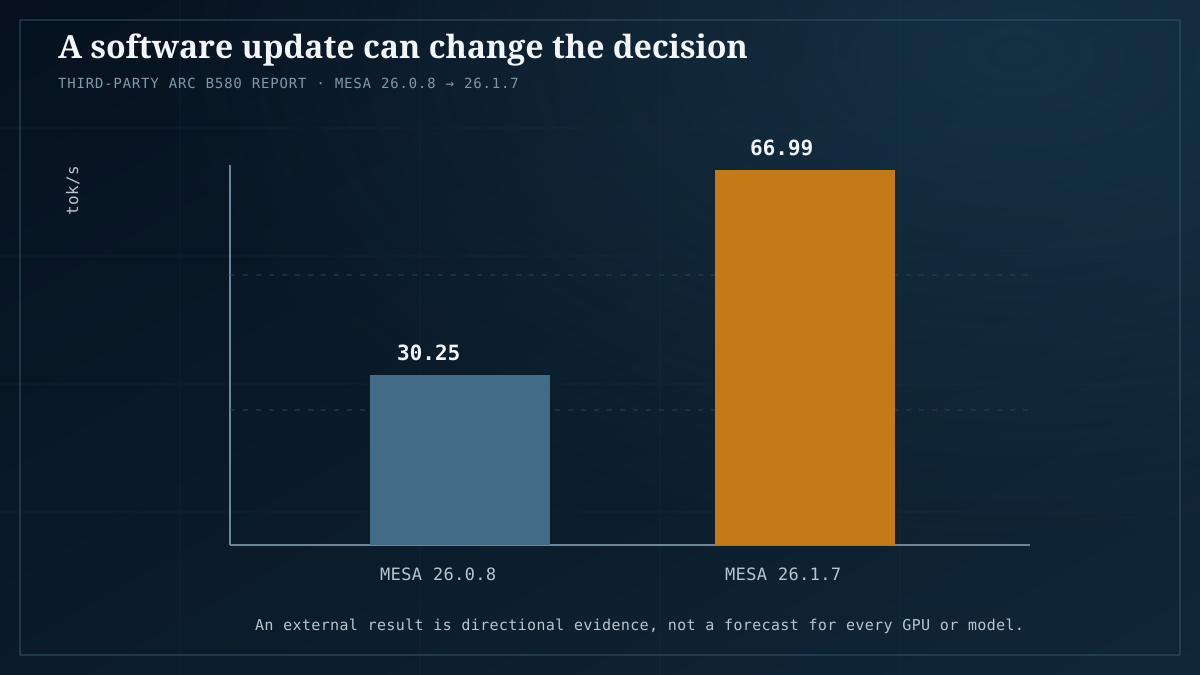
The second is a software-stack shift — and this one cuts against waiting, not for it. A third-party report on an Arc B580 found Q4_K_M decode roughly doubled, from 30.25 tok/s to 66.99 tok/s, after moving from Mesa 26.0.8 to 26.1.7. Same card, same model, same quant: about 2x from a software update. Our own measurements agree on the direction: OpenVINO beat Vulkan on the Arc B60, a stack-level choice changing measured throughput on fixed hardware. And Battlemage’s first year is largely a story of drivers maturing under a card that did not change.
Read those together and the implication is uncomfortable for waiters: on fixed hardware, software can move measured performance dramatically, often in your favor after purchase. The gains you are waiting for may arrive on the hardware you could already own. Waiting for new hardware to capture software gains is hedging the wrong variable. If anything, immature software on a platform is a reason to buy it now — you collect the improvements free as the stack matures."
Wait-triggers that are FOMO
Then there is everything else: rumored refreshes, leaked roadmaps, unmeasured new platforms, the vague sense that next quarter’s silicon will change everything. Our platform-decision framework sets the burden of proof plainly: a platform does not enter the decision until it is shipping and measured. A rumored card has no verified capacity, no measured throughput, no confirmed price. It is a placeholder for hope, and hope is not a spec.
The test is simple. Can you state, in numbers, what the thing you are waiting for will do for your workload? If yes, verify it is shipping and go read the measurements. If no, you are not waiting for a product; you are waiting for relief from anxiety, and no launch date provides that."
Resale and value: what holds, what does not
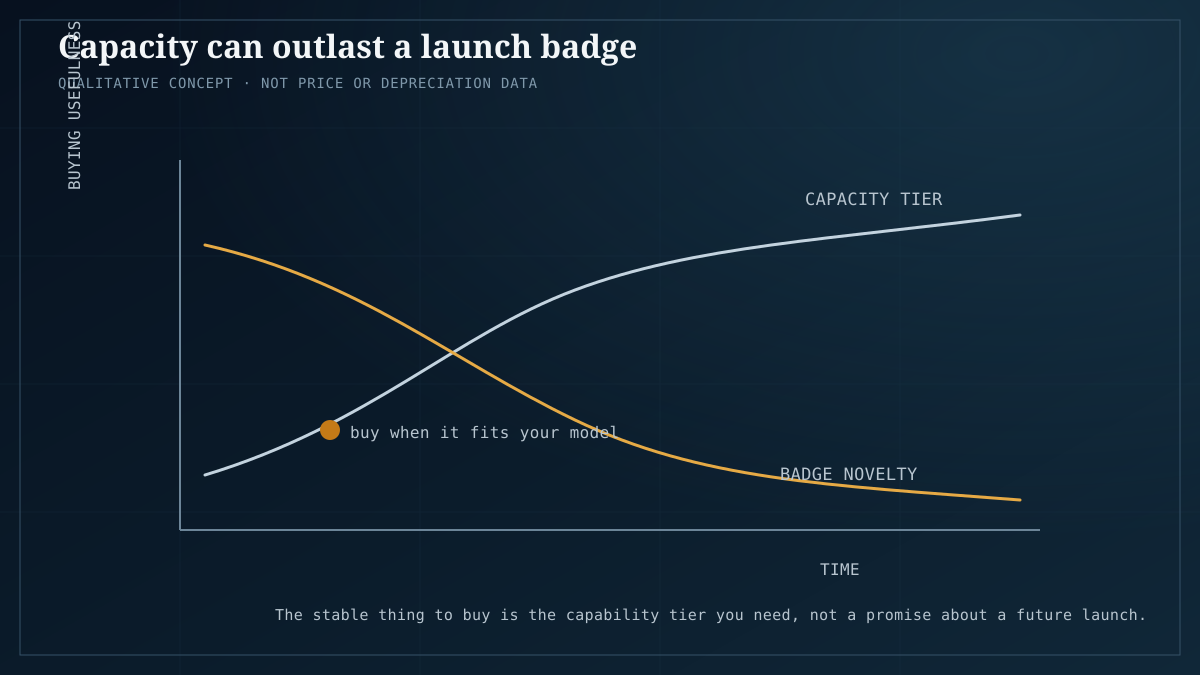
Label this section clearly: it is editorial — framework logic from a benchmark lab, not market analysis. We have no price data and make no price predictions.
What tends to hold value is the memory capacity tier. Capacity is the spec that keeps running the same models years later; a 24GB card does not stop fitting 24GB workloads because a successor launched. Capacity thresholds are the durable structure of this market — our single-versus-dual-GPU measurements identify an ~18GB crossover that decides when a second card makes sense, and thresholds like that are what buyers effectively pay for across a card’s whole life, first hand and second.
What tends not to hold value is the premium badge. The $9K RTX 5090 backlash is the cautionary shape: halo pricing is the hardest to recoup, because every new halo resets the reference point buyers use. The EVO-X2 resale threads are asking the right question in one respect — the resale-relevant issue with a ~$2,000 128GB machine is not the badge, it is whether the 128GB capacity tier is one you will still need. If yes, capacity is the part most likely to still be worth something. If you bought for the badge, that is the part that depreciates.
One more point, and it is the framework’s core: the best resale protection is buying the tier you actually need, no more. Overbuying capacity you never use is paying for value you never capture; underbuying is the trap our VRAM guide exists to prevent."
The decision table
| Your situation | Our call | Why |
|---|---|---|
| Workload fits in 24GB and budget matters | Buy used | Depreciation already happened; measured performance is stable |
| Workload fits a current, measured card at a price you accept | Buy new now | The tier does the job; software updates may speed it up for free |
| You need a large capacity tier that is shipping and measured | Buy new now | Capacity is the durable spec; waiting does not create tiers |
| Your trigger is a rumored refresh or unmeasured platform | Buy now | Burden of proof unmet; hope is not a spec |
| A measured, shipping change alters your capacity tier | Wait, briefly | Real trigger — re-run the tier math on measured data, then buy |
| The platform’s software stack is visibly immature | Buy now | Mesa and OpenVINO data: fixed hardware gets faster as software matures |
| You cannot state your workload’s memory and bandwidth needs | Wait — and research | Not a market wait; measure the workload first, starting with the VRAM guide |
Note the shape of the table: “wait” appears twice, and one of those is “go do your homework.” Most situations resolve to buy, because most waiting has no evidence behind it."
Honest caveats
We are a benchmark lab, not market analysts. Nothing in our data forecasts prices, demand, or resale values, and this article contains no price predictions. The resale section is reasoning about which specs are durable, labeled editorial, and you should treat it accordingly.
The Mesa doubling is a third-party report, not our measurement. We cite it as evidence that software moves fixed-hardware performance, not as a promise that any particular card will double. Our OpenVINO result corroborates the direction, not the magnitude.
Corpus threads are anecdotes. They are good evidence about what the community is anxious about, and no evidence at all about what the market will do.
Finally, “buy for the workload you run today” assumes you know your workload. If yours is shifting month to month, no timing strategy fixes that; the only hedge is capacity headroom, and choosing headroom is a tier decision, not a timing one."
FAQ
Should I just wait for the next generation?
Only if a shipping, measured product addresses your specific bottleneck. Run the test from this article: name the numbers. If you cannot, the wait is FOMO, and our platform-decision framework says unmeasured platforms do not enter the decision.
Is buying used risky?
The risks are condition, history, and warranty coverage — not performance. Measured performance is stable: a 24GB card runs the same quantized models regardless of who owned it first. Our used RTX 3090 analysis covers why it is the value-king pick and what depreciation already priced in.
What if prices drop right after I buy?
We do not forecast prices, so we cannot tell you they will not. What we can say: if you bought the right tier, a price drop does not take your workload away from you. Anchoring a purchase to price movements is how the $9K-flagship backlash happens — the alternative to buying a tier is waiting for a price you cannot predict.
Can software really double performance on hardware I already own?
In one measured case, roughly yes: an Arc B580’s Q4_K_M decode went from 30.25 to 66.99 tok/s across a Mesa update, per a third-party report. Our OpenVINO-beats-Vulkan result on the Arc B60 corroborates the direction. Treat it as evidence that the software stack matters, not as a guarantee for your card.
How do I figure out which tier I need?
Start with our VRAM guide to map your models to capacity, then check the measured GPU roundup for what actually delivers throughput in that tier. Then — and only then — decide new versus used.
Is the EVO-X2 at ~$2,000 a buy or a wait?
If the 128GB unified-memory tier matches a workload you run today, it is a buy-now candidate under this framework. If the question is what it will be worth later, that is resale anxiety, and our editorial read is that capacity tiers hold value better than badges do.