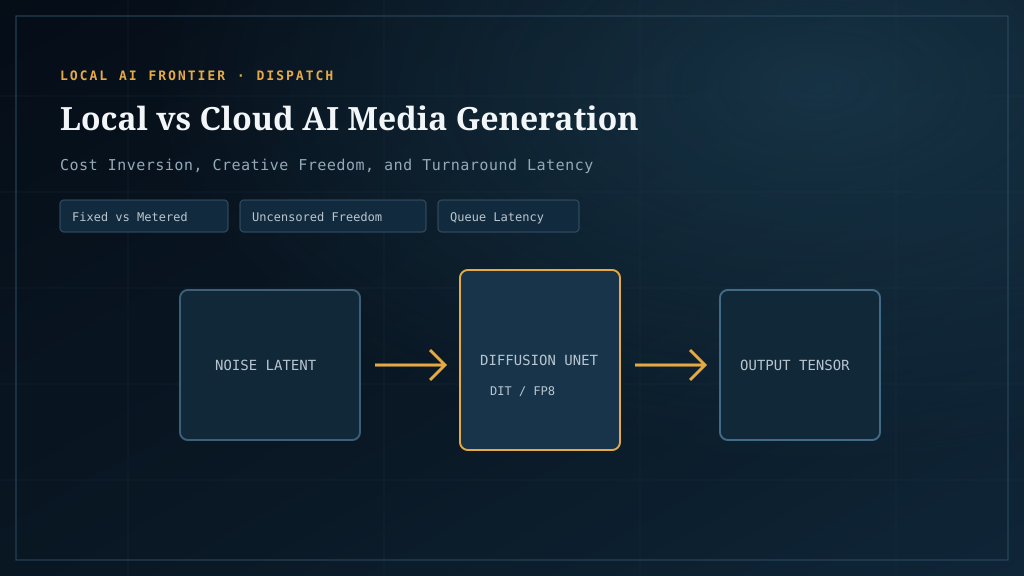
If you’ve ever stared at a $400 Replicate bill or a Midjourney subscription you barely use and wondered whether buying a GPU would be cheaper — this is the article. It’s the decision framework for AI image and video generation that most “best of” lists skip, because the answer depends on numbers only you have: your monthly volume, your electricity rate, and whether your work has a privacy or content-control requirement the cloud can’t meet.
The honest version isn’t “local wins.” It’s: for images, local is genuinely competitive at moderate volumes, and for video, the math is harder — but privacy often tilts it back. The rest of this piece is the receipts.
This is the pillar for a five-piece cluster on local vs cloud media generation. The four supporting articles go deep on each side — local image, cloud image APIs, local video, and cloud video APIs.
Why this decision is different for image and video than for text
We’ve written elsewhere about why local matters for LLMs. Image and video generation share the same thesis — privacy, cost inversion, control — but the math runs on different units.
Text is billed per token. A 7B model quantized to Q4_K_M runs on a $300 GPU, and you can generate for weeks before electricity matters. The break-even math is gentle.
Images are billed per generation. Cloud APIs range from $0.0002 to $0.15 per image depending on provider and model, with fal.ai at the cheap end and high-end Flux generations near the top. A local GPU has a fixed cost: depreciation plus electricity, divided by how much you actually use it. Whether local wins depends almost entirely on how many images you generate per month.
Video is billed per clip, and the range is brutal: $0.13 to $3.20 per generation on cloud APIs. Local video gen has a hard 24GB+ VRAM floor for the good models (Wan, Hunyuan) and generation times measured in minutes. This is the workload where local hardware hurts most — and where cloud often genuinely wins on convenience.
There’s also a second axis the cloud-image-API articles rarely discuss: the VRAM cliff. A 12GB card runs SDXL all day but OOMs on Flux.2. Hardware isn’t a single number; it’s a per-model ceiling. We have a Model Fit estimator for the LLM version of that question — the media-gen equivalent is coming.
The three questions that decide it
Strip everything else away and the decision reduces to three things.
1. What’s your monthly volume? Below a few thousand images or a few hundred clips a month, cloud is almost always cheaper — you’re not generating enough to amortize the hardware. Above it, local’s fixed cost starts winning. The exact line depends on the cloud API you’d otherwise use and your electricity rate. We’ll do the math below.
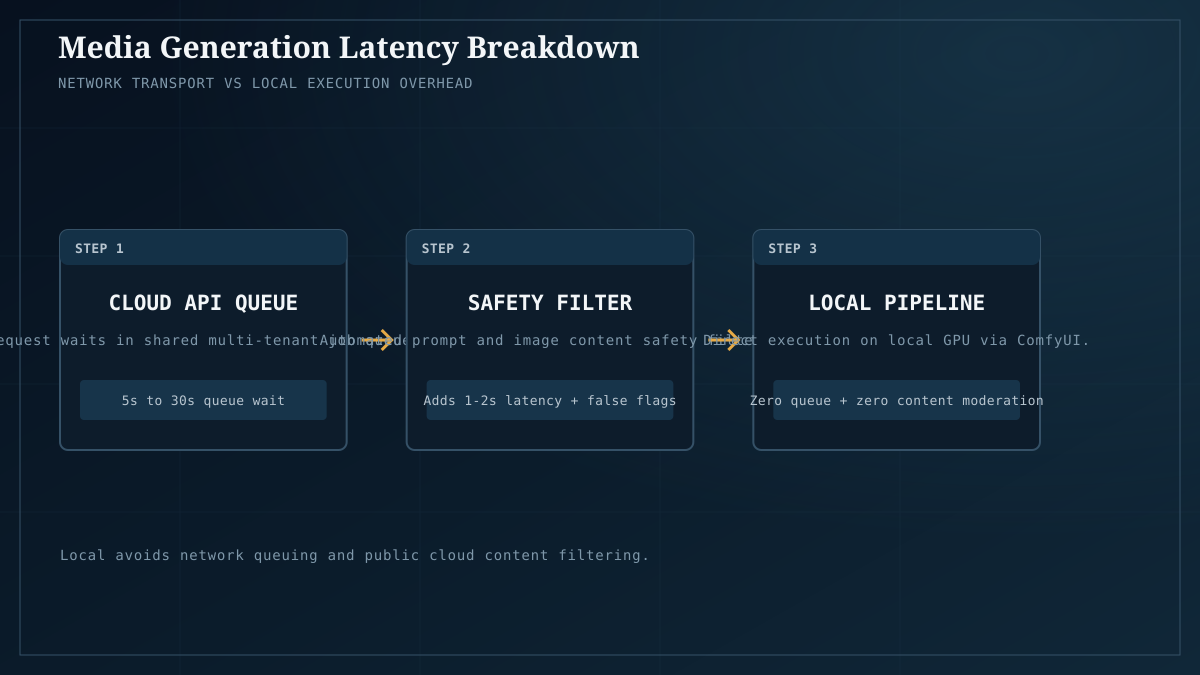
2. Is prompt or output privacy a requirement? If you’re generating campaign assets for a brand, product concepts under embargo, or anything commercially sensitive, every prompt and output flowing through a cloud API is data you’re handing a third party. Some providers train on API inputs (read the fine print). Some log them. Local generation never leaves your machine. This is the decision-maker’s question, and for commercial work it often outweighs cost.
3. Do you need content control the cloud won’t give you? Cloud platforms have content filters. They’re inconsistent, they shift over time, and they frequently block benign creative work — a complaint loud enough to spawn its own Reddit threads. Local generation has no filters. For artists, agencies, and brand teams, that’s not a fringe benefit — it’s often the primary reason to switch.
Answer those three and you have your answer. The rest of this article is the math that backs them up.
The break-even math (with worked examples)
The TCO literature on local vs cloud inference converges on a clean rule: if you’re spending more than $500–700/month on cloud API costs at stable volume, local typically wins. Below that, cloud is cheaper. That figure comes from MindStudio’s 2026 analysis and matches the academic on-prem LLM cost-benefit analysis — it’s roughly the point where a consumer GPU amortized over three years plus electricity undercuts the API.
But that rule of thumb is for text. For images and video, the per-unit economics differ. Let’s do the math.
Image workload break-even — the ~3,250 images/month line
Take a representative setup:
- Cloud baseline: $0.02 per image (a reasonable mid-range across fal.ai and Replicate for typical Flux/SDXL usage). Volume: variable.
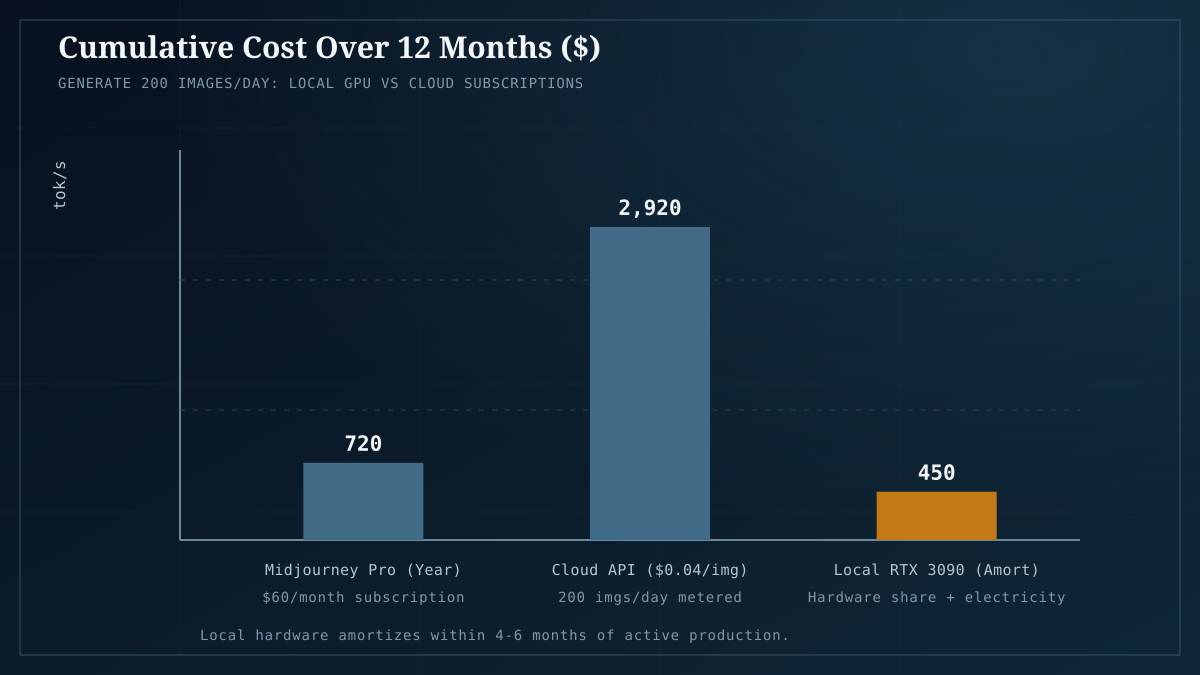
- Local alternative: an RTX 4090 rig at ~$1,800 total system cost, depreciated over three years = $50/month. Electricity at moderate use (say 4 hours/day at 450W wall draw, $0.15/kWh) = ~$8/month. Call it $65/month all-in.
Break-even: $65 ÷ $0.02 = 3,250 images per month, every month, for three years.
That’s not a huge number for a working creator or a small studio. If you’re generating 5,000+ images a month — storyboards, product variants, ad creative, dataset augmentation — local wins decisively. If you’re generating 200 images a month for an occasional blog post, cloud wins and the GPU never pays back.
Three things bend the line:
- Electricity. US average is $0.12/kWh. EU rates of $0.25–0.30/kWh push break-even 40–60% higher in required volume (SitePoint’s 2026 TCO piece). If you’re in Germany or California, add a third to the numbers above.
- Which cloud API you’d otherwise use. fal.ai at $0.0002/image for cheap SDXL is far harder to beat than Midjourney at $0.08/image effective. Pick your realistic cloud baseline before doing the math.
- Cloud prices are falling. A GPU you buy today has to keep winning against API prices that drop every year. JonnyZZz’s cost-return analysis makes this point well: aim to break even within 6–12 months, not three years, because the math gets less favorable over time.
Video workload break-even — why the floor is higher
Video is where local hurts. The math:
- Cloud baseline: $0.50 per clip is a reasonable average across the $0.13–$3.20 range cited in Renderful’s 2026 pricing roundup. Volume: variable.
- Local alternative: a video-capable rig is more expensive. An RTX 4090 (24GB) at ~$1,800 depreciated = $50/month. But video generation is slow — minutes per clip, not seconds — so realistic utilization is higher (say 8 hours/day at 500W, $0.15/kWh = $18/month electricity). Call it $70–80/month all-in.
Break-even at $0.50/clip: ~150 clips/month. That’s lower than images in absolute count, but most creators generate far fewer video clips than images. Unless you’re a studio doing high-volume commercial video work, cloud video APIs often win on convenience alone — and local only becomes the right call when the privacy or content-control questions (above) force it.
The honest summary
For most individual creators: cloud for both, with a local GPU only if image volume crosses a few thousand per month. For small studios and commercial work: local for images once volume justifies it, cloud still wins for video unless privacy demands local. For agencies and enterprise: local for both, because the privacy and IP-control premium dwarfs the hardware cost.
Where local wins, where cloud wins (per workload)
Images — local is genuinely competitive
Flux.1 runs on a used RTX 3090 (24GB, ~$700 on the secondhand market). SDXL runs on almost any 12GB card. The 2026 Dynamic VRAM optimization in ComfyUI lets large models spill to system RAM gracefully, which has materially lowered the floor. If you’re doing more than a few thousand images a month, or you need prompt privacy, or you need content control — local wins. Here’s the full local image setup.
Video — cloud often wins on convenience; local wins on volume or privacy
Video gen is the workload where the cloud argument is strongest. Wan 2.5 and Hunyuan want 24GB+ comfortable, with 40GB+ ideal. Generation times are long. The cloud video APIs (Runway, fal.ai hosting Wan/Hunyuan, Pika, Sora) are polished, fast, and don’t require you to maintain a rig. For most creators, cloud is the right call here. Local only wins when volume is high enough to amortize serious hardware, or when prompt/output privacy is non-negotiable. The local video piece is here, and the cloud video comparison is here.
The hybrid pattern most teams settle on
The teams we talk to mostly land on the same hybrid: local for high-volume image work, cloud for one-off video work, cloud for anything that needs frontier quality they can’t run locally. This matches what we see in the LLM world — local isn’t a religion, it’s a tool for a specific class of workload.
The pattern looks like:
- A single 24GB workstation (RTX 4090 or 3090) handles daily image generation, LoRA experimentation, and anything with privacy constraints.
- Cloud APIs (usually fal.ai for cost, or Runway for polished video) handle bursty video work and quality-sensitive one-offs.
- A budget envelope: cloud API spending capped at the break-even line, with local hardware as the marginal-cost-free option beyond it.
How to decide in five minutes
If you’ve read this far and want the decision tree:
- Is your work commercially sensitive? (Prompts are IP, outputs are embargoed, contracts forbid third-party processing.) → Local, full stop. The privacy answer overrides cost.
- Are you generating fewer than ~1,000 images or ~100 video clips per month? → Cloud. Hardware won’t amortize.
- Are you generating more than ~3,000 images per month? → Local for images. The math is clear.
- Are you generating high-volume video (200+ clips/month)? → Local for video if you can afford a 4090-class rig. Otherwise cloud.
- Do you need content control cloud platforms won’t give you? → Local. No filter is a feature, not a workaround.
Most readers land on cloud with a plan to revisit local when volume crosses the line. That’s a fine answer.
Where to go next
- Running Flux and Stable Diffusion locally — the honest cost and hardware guide — VRAM floors, GPU picks, the five optimizations that change the math.
- Cloud image generation APIs compared — Replicate, fal.ai, Midjourney, OpenAI — the pricing decision tree, billing models, hidden costs.
- Local video generation — Wan, Hunyuan, CogVideoX on your own GPU — what’s actually runnable on consumer cards.
- Cloud video generation APIs compared — Runway, fal.ai, Pika, Sora — the cloud video landscape and which provider wins for which use.
If you’re new to local AI in general, start with why local AI matters in 2026 — this cluster extends that thesis into media workloads. And if you’re trying to figure out whether your card can run a given model at all, the Model Fit estimator handles the VRAM math for LLMs (a media-gen equivalent is on the way).
Last verified: July 2026. Cloud API prices are falling — re-validate the break-even math quarterly before making a hardware commitment.