Most “best AI image generator” articles rank tools by output quality and stop there. That’s the wrong question. The output quality across the major cloud image APIs is genuinely close in 2026, and most readers can’t tell Flux from Midjourney from gpt-image-1 in a blind test. The real differentiator — the thing that determines whether you get a $30 bill or a $400 bill at the end of the month — is the billing model.
If you’ve already worked through the local-vs-cloud decision and decided cloud is the right call for your volume, this article is the provider picker. We’ll cover the four billing models, the four major providers, and a decision tree for picking one.
The four billing models (and where surprise bills come from)
This is what most introductions skip. Each cloud image API bills differently, and the model determines whether your costs are predictable or a roulette wheel.
Per-second GPU billing (Replicate)
Replicate bills by GPU-seconds consumed. An SDXL generation on an A40 costs ~$0.0059/second; an H100 runs $5.49/hour ($0.001525/second). If your generation takes 5 seconds on an A40, that’s about $0.03. If it takes 30 seconds because you’re running a multi-step workflow, that’s $0.18.
The gotcha: slow generations are expensive generations. A complex workflow with ControlNet, upscaling, and refinement can run 30–60 seconds and cost 10× a basic generation. The Modelslab developer guide covers this in detail. Per-second billing is flexible but unpredictable if you don’t profile your workflows.
Per-image billing (fal.ai)
fal.ai bills per image generated, typically $0.0002–$0.15 per image depending on model and speed tier. A standard SDXL generation might be $0.001; a Flux Dev generation at the fast tier is $0.05–$0.15. The price is fixed per generation regardless of how long it takes, which makes cost forecasting trivial.
Per-image billing is the most predictable model for production. Multiply your monthly volume by the per-image price and you have your budget. No surprises.
Subscription (Midjourney)
Midjourney bills $10/month (Basic, ~200 images) up to $120/month (Mega). Unlimited generation on the Standard tier ($30) and up, with relaxed-mode queueing. Effective per-image cost lands around $0.04–$0.08 depending on plan and how much you actually use it.
Subscription makes sense if you’re a steady user who wants zero marginal cost. It punishes occasional users — if you generate 50 images a month on the $30 plan, your effective cost is $0.60/image, far above fal.ai.
Token-bundled (OpenAI)
OpenAI’s gpt-image-1 (and DALL·E 3 before it) bills through the standard token API, with image cost bundled into the response token count. This is the hardest to forecast because the price depends on resolution and quality settings. It’s rarely the cheapest option, but if you’re already building on the OpenAI API for text, the integration simplicity is worth something.
Replicate — flexibility at a premium
Replicate is the most model-diverse cloud API. Almost any open-source model — Flux variants, SDXL pipelines, ControlNets, LoRAs, niche community models — is deployable with one click. You’re paying for that flexibility.
Pricing: GPU-seconds, billed per model. H100 at ~$5.49/hr, A40 at ~$2.25/hr. A standard Flux generation runs ~$0.02–$0.05.
Best for: Prototyping across many models, one-off jobs with unusual pipelines, anything where you need a model no other provider hosts.
Watch out for: Per-second billing on slow generations. A complex workflow that takes 45 seconds costs 9× what a 5-second generation costs, and the per-second rate silently scales. Set spending alerts. Most Replicate bill shocks come from workflows the user didn’t realize were slow.
fal.ai — the cost leader for production
fal.ai is the cost leader for production image generation, especially for high-volume workloads.
Pricing: Per-image, $0.0002–$0.15. The cheap end is SDXL-tier models at $0.001 or less; the expensive end is fast Flux Dev. Across the board, fal.ai runs 30–50% cheaper than Replicate for equivalent generations per Teamday’s 2026 comparison, and hosts 600+ models vs Replicate’s ~200.
Best for: Bulk production. If you’re generating thousands of images per month for a product, dataset, or content pipeline, fal.ai is almost always the right pick. The per-image billing makes budgeting trivial.
Watch out for: Less hand-holding. The docs are good but the community is smaller than Replicate’s. If you need a model fal.ai doesn’t host, you’re back to Replicate.
Midjourney — subscription simplicity
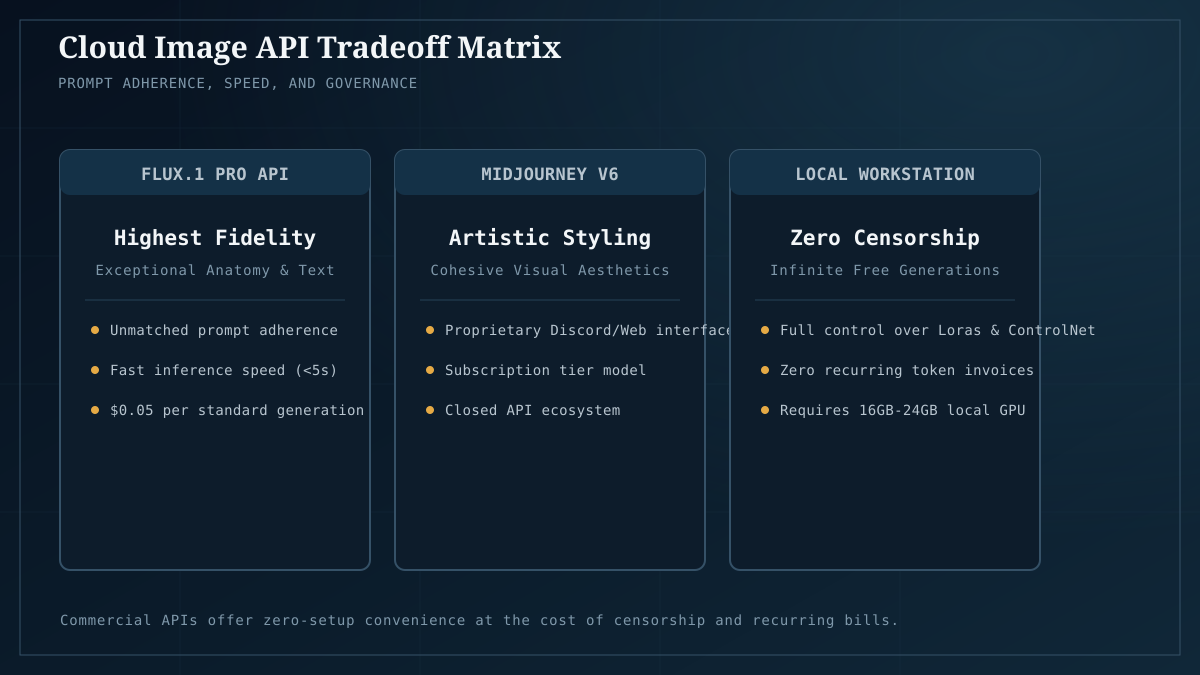
Midjourney is the polished commercial product. Closed-source model, subscription pricing, browser-based (and Discord-based) interface, no API in the traditional sense.
Pricing: $10/month (Basic, ~200 images) through $120/month (Mega). Standard at $30/month gives unlimited relaxed-mode generation.
Best for: Non-technical creators who want high-quality output without setup, prompt engineering depth, or API integration. If you’re making concept art or marketing visuals and don’t care about LoRAs, ControlNets, or workflows, Midjourney is the easiest path to good results.
Watch out for: Limited control. No LoRAs, no ControlNet, no node-graph workflows, no fine-tuning. You’re using their model their way. Content filters are stricter than open-model alternatives. No traditional API — you can’t integrate Midjourney into a programmatic pipeline the way you can with Replicate or fal.ai.
OpenAI (gpt-image-1 / DALL·E) — quality, less control
OpenAI’s image models are accessible via the standard OpenAI API. gpt-image-1 (2026) is a genuine quality leader for certain use cases — text rendering inside images, instruction-following, multi-turn image editing — at a premium price.
Pricing: Token-bundled, hard to compare directly. Expect 2–5× the per-image cost of fal.ai for equivalent resolution.
Best for: Workflows already built on the OpenAI API where integration simplicity matters more than per-image cost. Also for text-in-image generation, where gpt-image-1 is meaningfully ahead.
Watch out for: Cost. And content filters stricter than any other provider here. OpenAI is the most conservative of the major image APIs on what it will generate.
The pricing decision tree
You want the decision tree. Here it is.
1. Are you generating fewer than ~500 images/month? → Midjourney Standard ($30/month) if you want a polished product, fal.ai if you want programmatic access. Both will cost you under $50/month.
2. Are you generating 500–5,000 images/month via API for a product or pipeline? → fal.ai. Per-image billing, lowest unit cost, predictable budget. Replicate only if you need a model fal.ai doesn’t host.
3. Are you doing complex workflows (ControlNet, multi-step refinement, niche LoRAs)? → Replicate. Per-second billing hurts on slow workflows, but only Replicate has the model diversity for unusual pipelines.
4. Are you already building on the OpenAI API and want to add image generation? → OpenAI gpt-image-1. Integration simplicity outweighs the cost premium if you’re already there.
5. Are you a non-technical creator who just wants good images? → Midjourney. Don’t overcomplicate it.
When cloud image APIs beat local (and when they don’t)
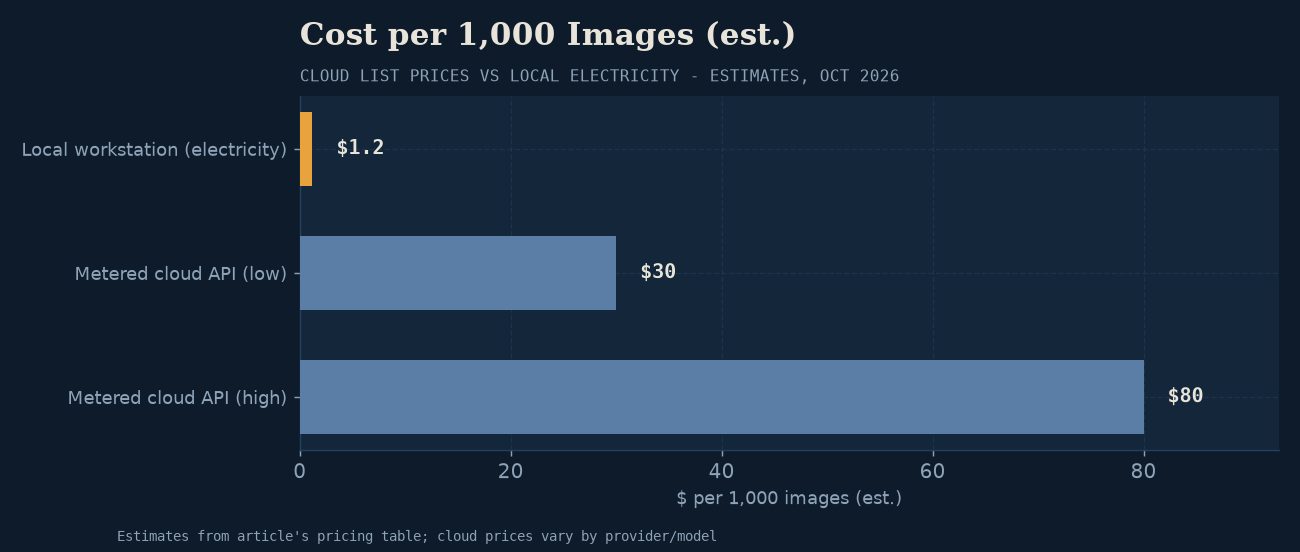
Cloud wins for low-to-moderate volume (under ~3,000 images/month), for any workload where you need models you can’t run locally (frontier-scale, latest proprietary releases), and for anyone who values zero setup over marginal cost.
Cloud loses when volume crosses the break-even line, when prompt or output privacy is required, and when you need content control the cloud platforms won’t give you. The full math is in the pillar article — for most working creators, the crossover happens around 3,000 images/month.
If you’re near that line and curious what local would actually take, the local image setup guide covers VRAM floors, GPU picks, and the optimizations that change the math.
The privacy question nobody else asks
For commercial work — brand campaigns, product concepts under embargo, agency client work, anything where the prompt itself is intellectual property — the cloud image APIs present a real question: where does your prompt go?
Every major cloud API logs inputs. Some reserve the right to train on them (read the fine print; it changes). For a hobbyist generating fan art, this doesn’t matter. For an agency generating campaign concepts for an unreleased product, it can be a contractual problem. Local generation eliminates the question entirely — the prompt never leaves your machine.
This isn’t an argument against cloud APIs. It’s an argument for knowing what you’re sending and reading the data-use terms before you put commercial work through one. We cover this in depth in the privacy section of the pillar article.
Where to go next
- Local vs cloud AI generation — the decision framework — if you haven’t done the break-even math yet, start here.
- Running Flux and Stable Diffusion locally — if your volume crosses the line, here’s the setup.
- Cloud video generation APIs compared — different economics, different providers, similar decision tree.
- Why local AI matters in 2026 — the broader local-vs-cloud thesis this cluster extends.
Last verified: July 2026. Cloud API pricing changes frequently — verify current rates on each provider’s pricing page before committing.