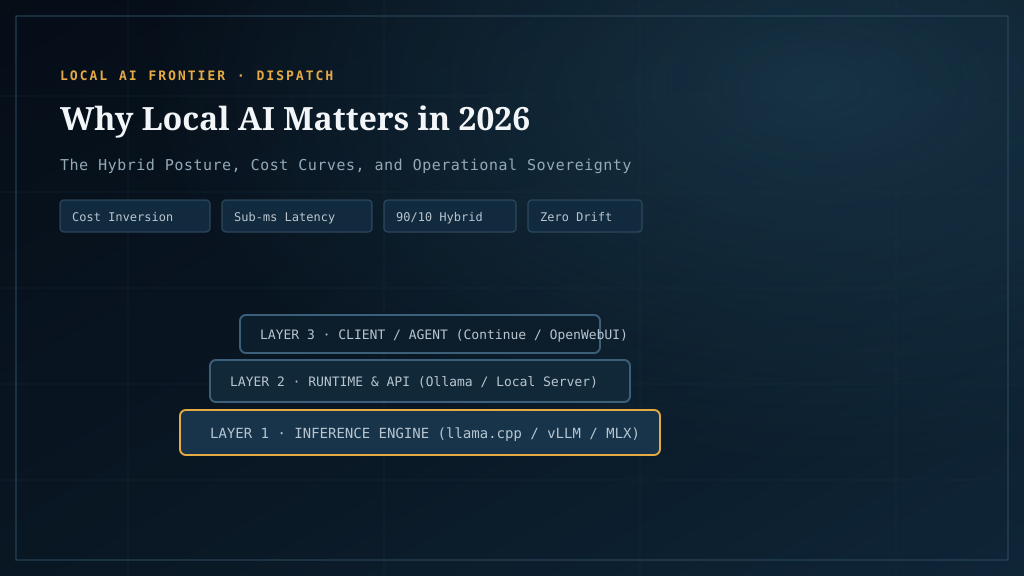
New to local AI? Start at /start-here/ for the five-step decision path, then read what to expect before buying anything.
For most of 2024, “local AI” meant tolerating an inferior, lobotomized model so you could proudly claim you ran it yourself. You endured sluggish 8B models that hallucinated basic Python code, struggled with 4K context windows, and took minutes to run on consumer hardware.
That compromise is decisively over. A 30B-parameter model quantized to Q4_K_M now lands within striking distance of 2025 frontier cloud models on everyday programming, reasoning, and extraction tasks. On a single $300 entry GPU with partial offload or a 24GB workstation card, it generates at 25 to 65 tokens per second.
So the pressing question for 2026 is no longer can you run AI locally. It is why bother, when frontier intelligence is accessible behind an API key for fractions of a cent per request?
The answer is not ideological purity or an anti-cloud crusade. It is architectural necessity, workload economics, and operational stability.
Four reasons that hold up under scrutiny
1. Privacy is a workload property, not an enterprise compliance checkbox
The moment your workload touches legal contracts, patient records, financial disclosures, proprietary codebases under embargo, or sensitive internal credentials, “we promise not to train on your data” stops being an acceptable architectural guarantee.
In the corporate world, third-party inference endpoints introduce immediate third-party risk:
- Data in transit across public networks.
- Cloud vendor logging and transient retention policies.
- Legal discovery risks where subpoenaed vendor databases expose customer inputs.
- Changing terms of service that retroactively modify data governance agreements.
Running weights on hardware you physically own or control inside a private perimeter is the only data protection posture that does not depend on someone else’s compliance officer. When the model runs on your workstation or private server, the prompt never converts into network packets. It exists solely in VRAM, executes, and evaporates.
2. The cost curve inverts violently at volume
Cloud APIs are deceptively cheap when you are prototyping. If you make twenty queries a day through a web client, an API costs pennies per month. Hardware makes zero economic sense for that usage pattern.
However, modern software engineering workflows do not make twenty calls a day. They employ autonomous coding agents (Continue, Aider, Claude Code), continuous integration test suites, automated document parsers, and synthetic data generators. A developer running a background coding loop that scans files, executes tests, and iterates on patches can easily burn 3 to 10 million tokens in a single productive working day.
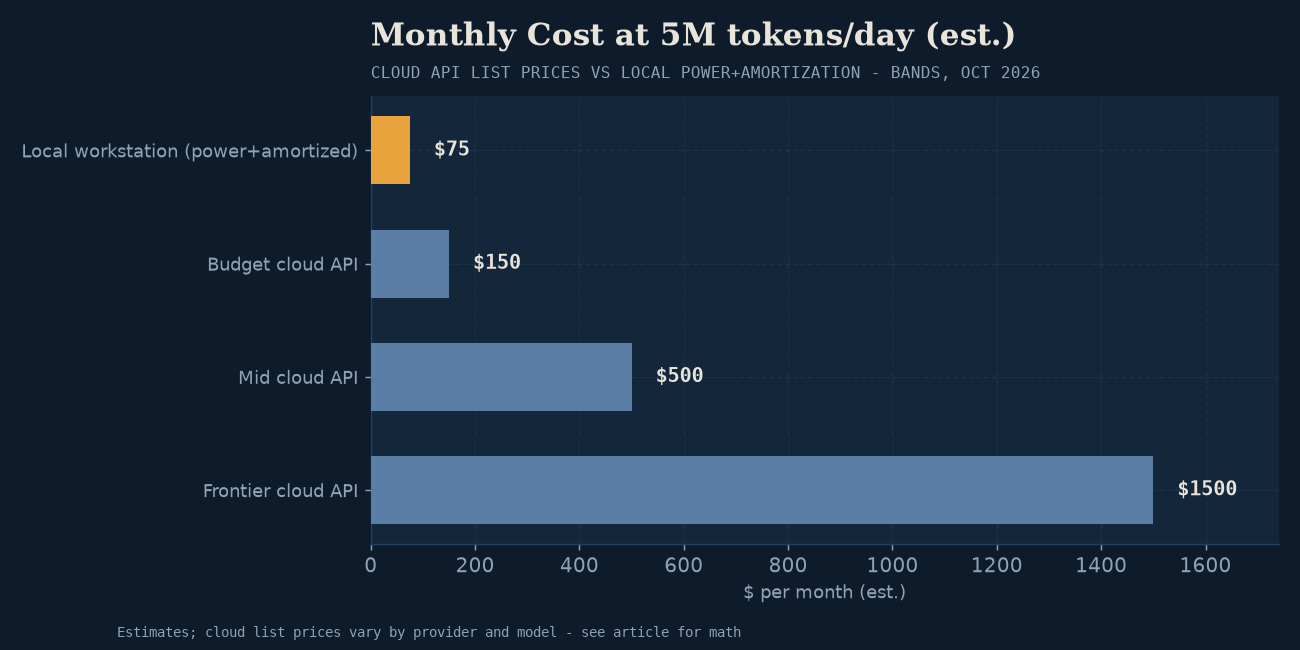
| Daily Volume | Monthly Tokens | Frontier API Cost ($3/$15 per M) | Mid-Tier Cloud API ($0.50/$1.50) | Dedicated Local Workstation |
|---|---|---|---|---|
| Low (50k tok/day) | 1.5M | ~$15 | ~$1.50 | ~$75/mo (amortized over 24 mo) |
| Medium (1M tok/day) | 30M | ~$300 | ~$30 | ~$75/mo (fixed hardware + power) |
| High (5M tok/day) | 150M | ~$1,500 | ~$150 | ~$75/mo (fixed hardware + power) |
| Loop Agent (15M tok/day) | 450M | ~$4,500 | ~$450 | ~$75/mo (fixed hardware + power) |
Local workstation baseline: $1,500 DIY build (e.g. used RTX 3090 24GB + host platform) amortized over 24 months ($62.50/mo) plus 150W continuous power consumption at $0.15/kWh (~$16/mo).
At agentic volume, the cost inversion happens within 30 to 60 days. Once the hardware is amortized, the marginal cost of a million tokens generated locally is strictly the cost of the electricity required to spin the cooling fans.
3. Latency is the ergonomic ceiling of autonomous loops
When a human chats with an AI assistant in a browser, a 600ms latency to the first token is imperceptible. The human reads slower than the model outputs.
When an autonomous agent executes a multi-step task, latency is the bottleneck that breaks usability. Consider an agent tasked with refactoring a module:
- Parse 10 source files and formulate an edit plan (3 LLM calls).
- Propose code changes to file A (1 LLM call).
- Run linter and inspect compiler error output (1 tool call).
- Revise patch and retry (2 LLM calls).
- Repeat across 5 dependent files (10 LLM calls).
Across 25 sequential model invocations, an external API round-trip averaging 400ms in network overhead adds 10 full seconds of pure transport latency—before factoring in model queue delays, TTFT (Time to First Token), and token generation time.
On a local engine (llama.cpp, vLLM, or MLX) communicating over a Unix domain socket or local loopback (localhost:11434), network transport latency is effectively zero (sub-millisecond). The model streams tokens instantly. A loop that feels agonizingly sluggish over a public API feels like an interactive terminal tool locally.
4. Operational sovereignty and model pinning
Cloud providers routinely deprecate, silently retune, or steer hosted models. In an API environment, you do not control the runtime. When an upstream provider applies a new alignment filter, adjusts quantization profiles behind the scenes, or throttles rate limits during peak hours, your production prompts can degrade without warning.
A local model is a static binary file with an immutable cryptographic SHA256 checksum on your NVMe SSD.
- If you benchmark prompt behavior in February on
qwen3-coder-30b-q4_k_m.gguf, that exact model will produce identical probability distributions in November. - There are no rate limits, no tier downgrades, and no 429 Too Many Requests errors when upstream servers experience an outage.
- Your entire workflow functions without an active internet connection—on an airplane, in an air-gapped facility, or during an ISP outage.
The hybrid posture: where the cloud still wins
Local AI advocates often fall into the trap of dogmatic absolutism. The objective is not to disconnect from the internet entirely; it is to build a resilient, cost-effective hybrid architecture.
The cloud remains undeniably superior in three key domains:
- Frontier reasoning and massive parameter scales: Models exceeding 100B active parameters (e.g. DeepSeek-V3, GPT-4o, Claude 3.7 Sonnet) require multiple enterprise H100/H200 GPUs that no rational individual or small business should host locally unless operating under strict legal necessity. For deep conceptual design, high-stakes architecture reviews, and multi-disciplinary reasoning, paying for a cloud API call is the correct engineering decision.
- Infinite context ingestion: Processing a 500,000-token codebase dump in a single prompt requires hundreds of gigabytes of KV cache memory. While local unified memory systems (such as high-spec Mac Studios) can achieve this, cloud infrastructure absorbs massive context bursts without hardware capital expenditure.
- Multimodal frontier media generation: High-end video generation models (Runway Gen-3, Kling, Sora) and cutting-edge audio synthesizers demand massive compute clusters that consumer hardware cannot match for turnaround speed.
The 90/10 production architecture
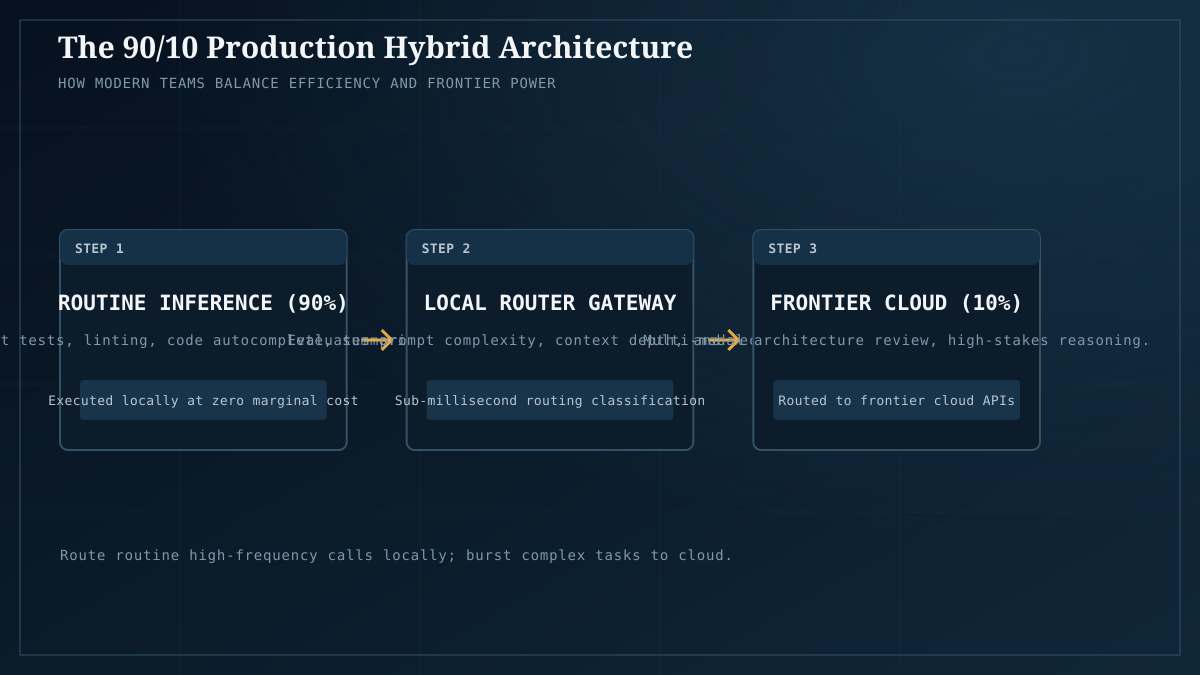
Mature teams and solo developers increasingly converge on a 90/10 hybrid architecture:
- 90% Local: Routine code autocompletion, lint corrections, unit test generation, local RAG document searches, transcription via Whisper, synthetic data extraction, and iterative agent loops run on local workstations or a shared local office box.
- 10% Cloud: Strategic planning, frontier code review, complex multi-domain reasoning, and large-context repository indexing route dynamically to frontier cloud APIs.
This posture provides the best of both worlds: zero monthly token anxiety for the bulk of high-frequency tasks, impenetrable privacy for core proprietary data, and instant access to frontier capabilities when a problem demands world-class intelligence.
The technological convergence that made this possible
Local AI in 2026 is viable because three distinct engineering disciplines converged:
- Modern quantization breakthroughs: Formats like GGUF with k-quants (Q4_K_M, Q5_K_M) demonstrated that reducing parameter weight precision from 16-bit floating point to 4-bit integer preserves 95%+ of downstream task performance while slashing memory requirements by 70%.
- Open cross-platform runtimes: The maturation of Vulkan backends (Mesa RADV on AMD, ANV on Intel) and optimized serving engines (llama.cpp, OpenVINO, MLX, vLLM) eliminated the historic CUDA vendor monopoly, allowing budget GPUs, mini-PCs, and unified memory architectures to run high-throughput inference.
- Architectural density improvements: Open-weights architectures (Qwen, DeepSeek, Llama, Mistral) reached unprecedented performance densities in the 8B to 35B parameter class, allowing models that fit within 12GB to 24GB of VRAM to outperform the 70B models of previous years.
Local AI is no longer a fringe hobbyist pastime. It is a pragmatic, cost-disciplined, and privacy-preserving foundation for modern software development.
If you are setting up your first workstation, start with Start Here for the five-step setup checklist. For the hardware landscape, see our measured breakdowns in Best GPUs for local AI, measured and Hardware platform decision. For open benchmark data, browse the benchmarks explorer.