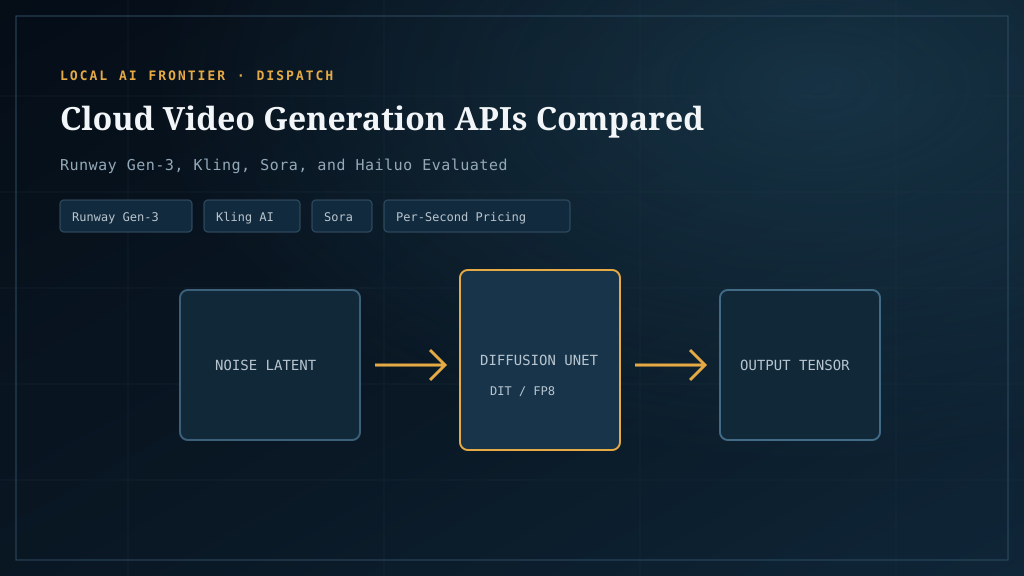
Cloud video generation is the strangest market in AI media. The price range per generated clip runs from $0.13 to $3.20 — a 25× spread across providers, with wildly different billing models, quality tiers, and content policies behind those numbers. There is no “best” video API. There’s the right API for your volume, your quality bar, and your tolerance for content filters.
This is the cloud counterpart to our local video generation guide. If you’ve worked through the local-vs-cloud framework and decided cloud is the right call for your video work, this article is the provider picker.
The cloud video landscape in 2026
Four providers matter. They’re not interchangeable.
Runway is the established commercial default — polished product, Gen-4 model, subscription pricing. The safe pick.
fal.ai hosts the open video models (Wan, Hunyuan, CogVideoX) on cloud GPUs and bills per-generation. The hybrid pick — open models, no hardware, lower cost.
Pika is the creator-friendly alternative. Strong on stylized content, simpler interface than Runway, subscription model.
Sora (OpenAI) is the quality leader on certain axes — coherence across complex scenes, prompt adherence. Also the strictest on content filtering and the most expensive for high-volume use.
A fifth category worth noting: Replicate hosts many of the same open video models as fal.ai but with per-second GPU billing rather than per-generation. Useful for one-off experimentation but rarely the cost leader for production.
Runway — the established default
Runway is what most people mean when they say “AI video generation.” Gen-4 is a polished model with strong prompt adherence and motion coherence. The product UX is the best in the category.
Pricing model: subscription tiers with monthly credit allowances, plus the ability to buy additional credits. Plans start around $15/month and scale to enterprise. Credits map to generation length and resolution — a 10-second 1080p clip costs more credits than a 4-second 720p clip.
Strengths:
- Gen-4 quality is consistently strong across prompt types.
- The most polished interface in the category — image-to-video, text-to-video, video-to-video, all clean.
- Strong commercial positioning: licensing terms are clear, content ownership is clear, brand-safe.
Watch out for:
- Subscription means you pay even in months you don’t use it. The break-even vs pay-per-generation depends heavily on volume.
- Content filters are stricter than open-model alternatives. Brand-safe cuts both ways — some legitimate creative work gets blocked.
- Less prompt-level control than running models directly. No LoRAs, no fine-tuning, no workflow customization.
Best for: Commercial production where polish, predictability, and clear licensing matter more than unit cost.
fal.ai (hosting Wan/Hunyuan) — the open-model-on-cloud path
fal.ai hosts the major open-source video models — Wan, Hunyuan, CogVideoX, LTX — and bills per-generation. This is the most interesting option in the category because it splits the difference between local and cloud.
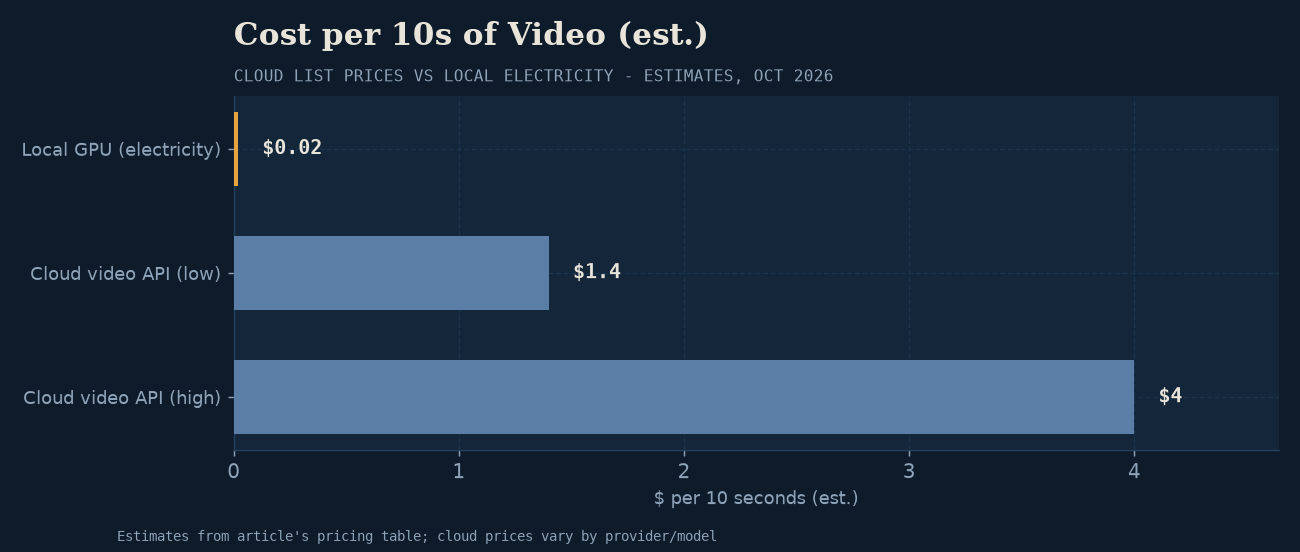
Pricing model: per-generation, in the $0.13–$3.20 range depending on model, length, and resolution. Per Renderful’s pricing roundup, this spans the full cloud video market — LTX-Video on the cheap end, high-resolution Hunyuan on the expensive end.
Strengths:
- Open models, no hardware. You get Wan and Hunyuan quality without buying a 4090.
- Per-generation billing is predictable. Multiply volume by per-clip price for a budget.
- Cheaper than Runway for equivalent quality on most workloads, because you’re paying for compute rather than a subscription margin.
- Model diversity — swap between Wan, Hunyuan, CogVideoX as the open ecosystem evolves.
Watch out for:
- Less polished than Runway. The UX is API-first; if you want a turnkey creative tool, this isn’t it.
- Fewer features — no Runway-style motion brush, advanced camera controls, or commercial product features. Just the models.
- The same open models you could run locally. If your volume crosses the break-even line, local hardware running the same model wins on cost.
Best for: Technical users who want open-model quality without the hardware investment, and high-volume production where per-generation economics beat subscription.
Pika — the creative-friendly alternative
Pika sits between Runway and fal.ai. Subscription model like Runway, simpler interface, strong on stylized creative content (animation, anime, specific art styles) where it sometimes outperforms Runway subjectively.
Pricing model: subscription tiers, comparable to Runway.
Strengths:
- Excellent on stylized content. For animation-adjacent work, often the best commercial option.
- Simple, fast interface. Lower learning curve than Runway.
- Generous free tier for testing.
Watch out for:
- Less consistent on photorealistic and complex scene coherence than Runway or the top open models.
- Smaller community and ecosystem than Runway.
- Subscription economics — same caveat as Runway for low-volume users.
Best for: Creators whose work is stylized or animation-adjacent, and who want a simpler tool than Runway.
Sora — the quality leader with limits
Sora (OpenAI) leads on certain quality dimensions — complex scene coherence, long-duration generation, physics realism — and is the strictest on content policy.
Pricing model: Bundled with ChatGPT Pro and available via API on OpenAI’s standard token-based billing. Expensive at high volume; quality premium for low-to-medium volume work.
Strengths:
- Best-in-class on complex scene coherence and physics. For shots that need realistic motion across multiple subjects, Sora often leads.
- Long-duration generation (60+ seconds) where most competitors cap at 10–15.
- Strong prompt adherence for complex instructions.
Watch out for:
- Content filters are the strictest in the category. Sora will refuse prompts the other providers handle fine. If your work touches any edge case — violence, even stylized; specific body types; political content — expect friction.
- Cost. At volume, Sora is the most expensive option here.
- Slower generation times for the highest-quality tiers.
Best for: Work where the quality premium is worth the cost and the content filters don’t interfere. Sora is excellent for brand-safe commercial production and limiting for creative work outside the mainstream.
The pricing decision tree
1. For commercial production (volume matters, predictability matters): → Runway subscription if you want a polished product, fal.ai if you have technical capacity and want open-model quality at lower unit cost. Both win for different reasons.
2. For content creators (subscription economics, polished UX): → Runway for photorealistic and complex work, Pika for stylized and animation-adjacent work.
3. For prototyping and one-offs (pay-as-you-go): → fal.ai per-generation billing. No subscription overhead, cheapest path for low volume.
4. For maximum quality on complex scenes: → Sora, if the content filters don’t block your work and the cost premium fits your budget.
5. For technical users who want open models but no hardware: → fal.ai. Same Wan/Hunyuan models you’d run locally, billed per clip.
The content-control question (censorship, IP, brand safety)
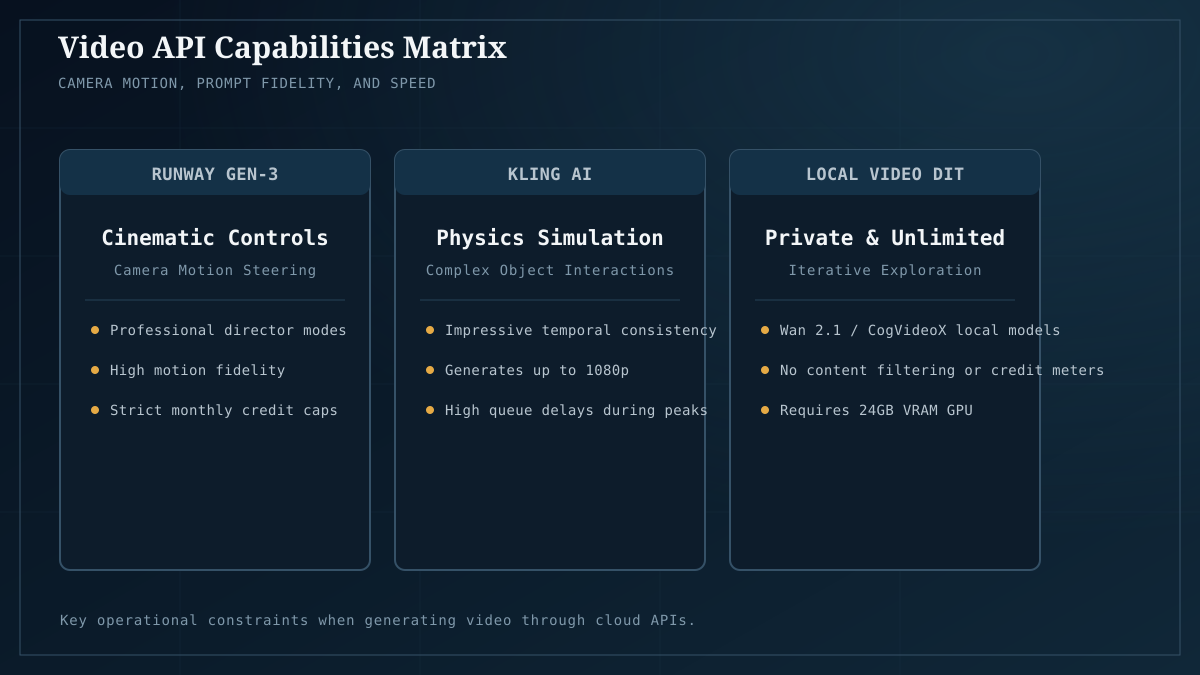
Cloud video platforms have content filters, and those filters are inconsistent across providers and over time. The pattern from image generation repeats here, sharper: Sora is strictest, Runway is moderate, fal.ai (hosting open models) is most permissive because the underlying models aren’t filtered.
For commercial brand work, this is a feature — the filters protect you. For creative work outside brand-safe territory, this is friction. Know your work, know the platform’s policy, and pick accordingly. If your work routinely runs into content filters and you can’t switch platforms, local video generation is the answer — local models have no filters at all.
A second consideration for commercial work: who owns the prompts and outputs. Cloud providers log inputs. Some reserve rights to use outputs for training. For brand campaigns under NDA or agency client work where the prompt is IP, read the terms carefully. Local eliminates the question entirely.
When cloud video is the right call
For most creators and most use cases, cloud wins for video. The reasons:
- No hardware risk. Video-capable rigs are expensive (24GB+ VRAM floor; see the local guide for the math). Cloud eliminates the capital cost.
- Better polish. Runway and Sora are ahead of open models on UX features and certain quality dimensions.
- Pay-as-you-go fits low volume. If you generate 50 clips a month, no cloud API is expensive, and the alternatives all require hardware investment.
Cloud loses when volume crosses the break-even line, when privacy requires local, or when content filters block legitimate work. For those cases, the local video piece covers what’s actually runnable on consumer hardware.
When it isn’t (and the local alternative)
If your monthly video volume crosses roughly 150–200 clips at typical cloud pricing, a local video-capable rig starts paying back. The math is harder than for images — the hardware is more expensive, generation is slower, and the floor is higher — but it exists. Studios doing high-volume commercial video work are the natural local customer.
For anyone with privacy or content-control requirements that cloud can’t meet, local is the answer regardless of cost. The local video guide covers Wan, Hunyuan, and CogVideoX in depth, including the optimizations that make marginal cards viable.
Where to go next
- Local vs cloud AI generation — the decision framework — the pillar, with the full break-even math.
- Local video generation — Wan, Hunyuan, CogVideoX on your own GPU — if your volume justifies hardware or privacy requires local.
- Cloud image generation APIs compared — different economics, different providers, but the decision framework rhymes.
- Why local AI matters in 2026 — the broader local-vs-cloud thesis this cluster extends.
Last verified: July 2026. Cloud video API pricing and model availability change monthly — verify current rates and model lineups on each provider’s page before committing.