“Is your data private?” is the wrong question. The right one is: where does the computation happen, and who can see the inputs? Everything else — encryption, enterprise agreements, retention promises — is a contractual mitigation layered on top of a fundamental architectural fact. If your data leaves your machine to reach a model, the provider can see it, no matter what their policy says today. Policies change. Architectures don’t.
This is the case for local AI as a privacy measure, made precisely rather than as a slogan. We’re not going to claim local is always the answer — it isn’t. We’re going to show what “private” actually requires, where the cloud’s privacy claims hold up and where they’re load-bearing on trust, and what a local setup that genuinely earns the word looks like.
If you’re new to the why of local AI more broadly, start with why local AI matters in 2026. This piece is the privacy deep-dive — one of the four reasons local wins, and the one where the gap between marketing and reality is widest.
The threat model, stated plainly
Any honest privacy argument starts with a threat model: who are you keeping the data from, and what are the consequences if they see it? There is no “private in general.” There’s private against a specific adversary under specific assumptions. The common ones in local-AI use:
- A provider’s training pipeline. Many cloud AI terms allow your inputs to be used for model improvement. Even with “we won’t train on your data” toggles, the inputs transit their infrastructure.
- A provider’s retention window. Prompts and outputs are commonly logged for abuse monitoring and safety review — by humans, in some cases — for 30 days or longer.
- A data breach. Logs are stored somewhere. Stored data is breachable data.
- A subpoena or lawful-access request. Data a provider holds is data a provider can be compelled to produce.
- A terms-of-service change. Today’s retention policy is not next year’s.
Against those adversaries, the cloud’s mitigations are contractual: an enterprise agreement, a no-training toggle, a SOC 2 report, a DPA. They reduce risk. They don’t eliminate the structural fact that the data was on someone else’s machine. Local inference changes the architecture: the inputs never leave hardware you control, so most of that threat surface simply doesn’t exist.
Honest caveat: local does not protect against an adversary who has compromised your machine (malware, a seized laptop), against you pasting secrets into a different cloud tool, or against a model that exfiltrates data over a network if you’ve given it tools and internet access. Local is necessary for the architectures we’ll describe; it is not sufficient on its own. We’ll cover what “sufficient” requires below.
Why cloud “private” modes aren’t the same thing
Every major cloud AI provider offers some flavor of “your data isn’t used for training.” That’s a real and meaningful promise — for the threats it covers. It does not cover:
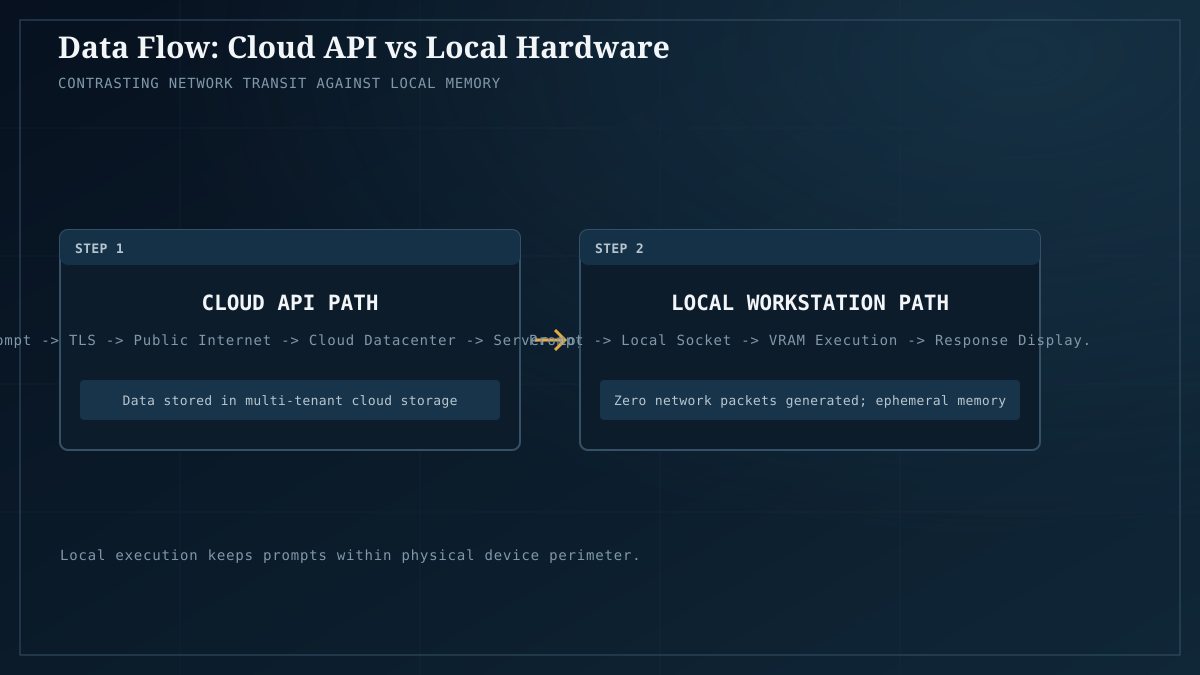
- Transit and processing logging. Even zero-retention enterprise tiers log inputs transiently for inference, abuse detection, and safety filtering. “Zero retention” usually means “deleted after X,” not “never stored.”
- Human review. Several providers’ terms permit human review of inputs flagged by automated safety systems. The threshold varies; the existence of the pathway is the point.
- Subprocessors and region routing. Where the request is processed, and by whose infrastructure, is often not the region you assume.
- The moving goalpost. A privacy posture you verified in January can change by July. Enterprise customers get notice; individuals often don’t.
None of this is a scandal. It’s the honest cost of sending data to a service you don’t control. The point is that “we don’t train on your data” and “your data is private” are different statements, and the second one is doing a lot more work than the first.
What “private” actually requires (the checklist)
A setup earns the word private when it meets all of these:
- The model runs on hardware you control. Not “dedicated capacity on a provider’s cloud” — your machine, your office, your rack.
- Inputs never transit a third-party network to reach inference. No API call leaves your boundary.
- The model weights are a pinned, local file — not a version a provider can swap or deprecate. (This is the same reason model-pinning matters for reproducibility: your benchmark means the same thing in November as it did in July.)
- Transcripts and logs live in a store you control — a local database, an encrypted volume — not a vendor’s backend.
- You’ve closed the obvious exits. No telemetry, no auto-update phoning home with usage data, no network access for the model itself unless you explicitly grant it.
If any one of these fails, you have a mitigated privacy posture, not a private one. The mitigations may be perfectly adequate for your threat model — but say what it is.
What a genuinely private setup looks like
Here’s the concrete version. The components are all things we’ve built and run on the lab fleet — four machines across Intel Arc, AMD, and NVIDIA (see the fleet for the topology).
The model server, local. Ollama or llama.cpp running on your own GPU. The request loop is browser → local UI → localhost:11434 → model. Nothing in that chain touches a third party. This is exactly the $300 starter — a single Intel Arc B580 or any 12GB+ card, a model pulled as a local GGUF file, and an OpenAI-compatible endpoint that never leaves the machine.
The transcript, local. Open WebUI (or equivalent) stores chat history in a local SQLite database. The file is on your disk. You back it up; you encrypt it; you control it.
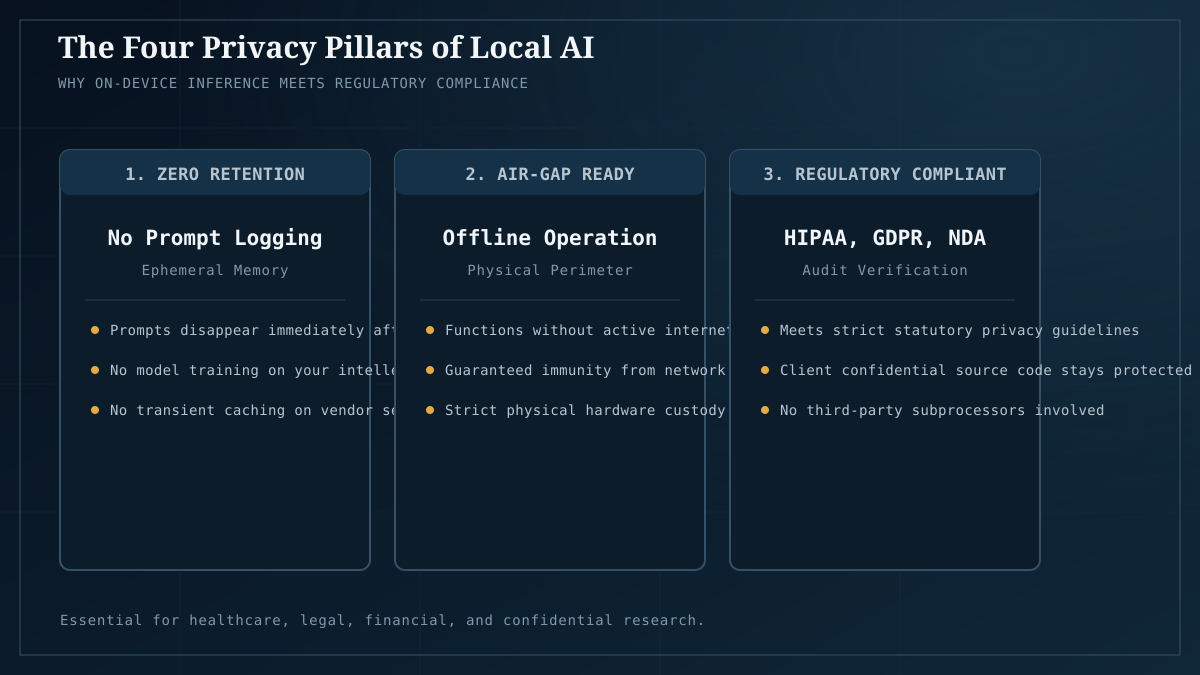
Offline operation. Once the model is pulled, no internet connection is required. The machine can be air-gapped and still serve inference. This is the property that matters for the regulated-industry cases below — a clinic laptop on a closed network, a lawyer’s machine with no external route, a journalist’s field laptop off-grid.
Pinned weights. The model is a specific GGUF file with a specific sha256. When we benchmark, we publish the hash — same file, same flags, same numbers. For privacy the point is sharper: a pinned local model cannot be silently swapped for one that behaves differently or that a provider has instrumented. The file you vetted is the file that runs.
Where this gets serious: regulated and sensitive work
The generic privacy argument above is true for everyone. For some readers it’s also a compliance requirement, and the architecture matters more than any policy:
- Legal — client communications, work product under privilege, matter details. A prompt containing facts about a case is a disclosure risk if it leaves the firm.
- Healthcare — patient data under HIPAA (US), GDPR health-data provisions (EU), and equivalents. “De-identify before sending to the API” is advice that fails the moment the model’s job is to help with the identifiable record.
- Finance — client portfolios, pre-release filings, M&A details. Insider-information rules make cloud inference of certain content legally untenable.
- Journalism & activism — source identities, unpublished findings, communications. The threat model here includes state actors, not just commercial retention.
- Therapists & coaches — session content is among the most sensitive data there is.
For each of these, “is local AI compliant/acceptable?” depends on the specific regulation and how you’ve configured the setup — and we are not your lawyer or compliance officer. What we can say architecturally: local inference is the only configuration where the regulated data doesn’t have to leave the regulated boundary in the first place. That’s a categorically easier compliance position than “we sent it to a provider and relied on their DPA.” A full treatment of each industry is its own article; treat this as the architectural thesis they all rest on.
The honest limits (read this part)
Local is necessary for the privacy posture above. It is not automatically sufficient:
- A compromised host leaks everything. If your machine has malware, or you’ve given an agent tool access and network egress, the model’s privacy is irrelevant — the data walks out another door. Privacy starts with host security.
- “Local” is not “air-gapped” by default. A networked local server is still a networked server. The genuinely high-assurance version means no route to the internet for the inference path — and explicit thought about how you pull model updates.
- Open-weight models are not magic. Running a model locally means you are responsible for what it does — including its failure modes, its biases, and its outputs. Privacy is about data flow; model behavior is a separate axis you still own.
- It doesn’t protect you from yourself. If you copy a secret and paste it into a cloud tool because you feel safe about your local setup, the architecture didn’t fail — you did.
The honest framing: local inference removes the provider from your threat model. It does not remove every adversary. For most readers, removing the provider is the largest single reduction in risk available. For high-assurance cases, it’s the precondition for the rest of the work.
If you want to go further
- The starter → Self-host your own ChatGPT for $300 — the minimum private setup, end to end.
- Point it at sensitive documents, locally → Run a private RAG knowledge base — chat with your own files without them leaving the machine.
- The hardware question → Run a 30B model on a $300 GPU and the Model Fit estimator for the VRAM math.
- Scaling it across a team, still private → Home AI server: a four-node fleet — when one machine isn’t enough but the boundary stays yours.
The takeaway
Privacy isn’t a setting. It’s a consequence of where the computation happens. The cloud can promise privacy; only local architecture can provide it as a structural property rather than a policy. For casual use, the cloud’s promises are usually fine. The moment your data has legal, medical, financial, commercial, or source-protection sensitivity, “we won’t look at it” stops being an acceptable substitute for “they can’t.”
That’s the case — not “local is always private,” but “local is the only configuration where private is even architecturally possible.” Everything else is risk reduction on top of a fundamentally different shape of risk.