Continuously updated roster: this snapshot now lives on as the living tracker at /models/ — checked monthly, with per-model “last verified” dates. This July snapshot stays for the tier analysis below.
Every “best open-source LLM in July 2026” list on the front page right now — Taskade, Thunder Compute, AceCloud, the rest — names the same five models: GLM-5.2, DeepSeek V4, Kimi K2.7 Code, Qwen3.6, MiniMax M3. They’re correct. They’re also nearly useless on their own, because not one of those roundups answers the only question a local-AI reader actually has: will it run on the card I own?
This is that list, sorted the way our lab sorts things — by what fits.
The one distinction roundups keep blurring
“Open weights” and “runnable locally” are not the same thing. A model with open weights you can’t load is just an API with extra steps.
- GLM-5.2 is roughly 744B total parameters (~40B active) — MoE, MIT-licensed, on HuggingFace. It also needs the better part of a datacenter to load unquantized. Unsloth ships dynamic GGUFs that can run locally, but on multi-GPU rigs most readers here don’t have.
- Kimi K2.7 Code is ~1T total / ~32B active, MoE, modified-MIT. Same story: open weights, frontier scale. ~600GB–1TB of GPU memory at FP16. That is not a workstation problem.
Both are genuinely wins for the open ecosystem — having frontier-class weights outside a vendor API matters. But for the audience reading a site called Local AI Frontier, they are API-and-cloud options that happen to have open weights, not daily-driver local models. We’re going to be honest about that and put them in a separate bucket below.
The actual local-runnable field, July 2026
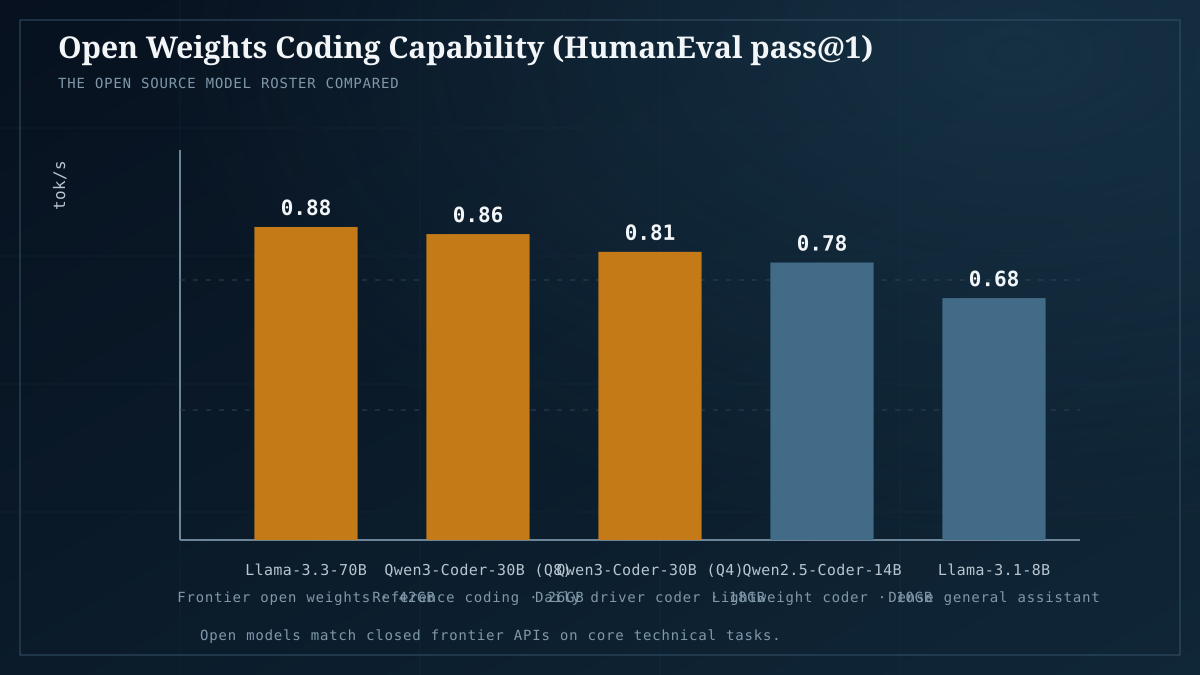
These are the models we’d actually put on a card you can buy this month. Sorted by where they fit.
Tier 1 — fits on a 12GB card (the $300 floor)
The model class that makes the “$300 floor” real. Mix of small dense and small-active MoE.
| Model | Type | Active params | Rough Q4 footprint | Best for |
|---|---|---|---|---|
| Qwen3-Coder-30B-A3B | MoE | ~3B | ~18GB (tight at 12) | coding — see bm-002 |
| LFM2.5-8B-A1B | MoE | ~1.7B | ~6GB | fast general work — see bm-007 |
| Mistral 7B | dense | 7B | ~6GB | the safe default |
| Gemma 3 12B | dense | 12B | ~8GB | strong general quality |
| Granite 4 7B / 1B (IBM) | dense | 7B / 1B | ~6GB / ~1GB | underappreciated; 1B runs on a laptop |
| SmolLM3 3B | dense | 3B | ~2.5GB | “best small model to play with” (r/LocalLLaMA) |
The MoE entries here are the interesting shift: a 30B-total model that only activates 3B per token gives you “30B-class quality, 3B-class speed and VRAM.” That trade is the single biggest thing that’s changed since 2024. We wrote a whole piece on it: The MoE shift.
Tier 2 — needs a 24GB card (the $400–$700 tier)
| Model | Type | Active params | Rough Q4 footprint | Best for |
|---|---|---|---|---|
| Qwen3.5/3.6 mid-size MoE | MoE | varies | ~16–20GB | high-end mid-size general/coding |
| EXAONE 4.0 32B | dense | 32B | ~19GB | strong dense quality |
| Gemma 3 27B | dense | 27B | ~16GB | the upper bound of single-card dense |
This is the Arc B60 / RX 7900 XT / RTX 4090-class tier. Once you’re here you stop worrying about “will it fit” for most work and start worrying about tok/s — which is where the card choice actually starts to bite.
Tier 3 — multi-GPU / workstation territory
70B-class dense and the larger MoEs. A single RTX 4090 won’t hold a 70B at a usable quant; you’re either at 2×24GB or you’re dropping context hard. We cover the part lists in Builds.
Tier 4 — “open weights, but not for you”
The frontier open-weights models. Worth cheering for, not worth pretending you’ll run on a desktop:
| Model | Total / active | Honest status for local |
|---|---|---|
| GLM-5.2 | ~744B / ~40B | open weights; realistically API or quantized multi-GPU |
| Kimi K2.7 Code | ~1T / ~32B | open weights; realistically API |
| DeepSeek V4 | large MoE | open weights; partial local possible, not daily-driver |
| MiniMax M3 | large MoE | open weights; API-tilted |
We’re not dismissing these. We’re saying: if your workload genuinely needs GLM-5.2-class reasoning, the cloud/hybrid path is the honest answer, and that’s the 10% case we’ve already ceded to the cloud. Local AI is not a religion.
The two things the roundups won’t tell you
First, the model carousel moves monthly now. A July 2026 list is stale by September. The honest way to use any roundup — including this one — is as a snapshot of what’s runnable right now, not a buying decision. The buying decision is “pick a model class that fits your card, then grab whatever the current best-in-class is when you actually sit down to download.” The Model Fit estimator answers the first part; this list answers the second, today.
Second, quantization is doing more work than the model choice is. Most of the “this model is amazing” signal in 2026 is actually “this model at Q4_K_M is amazing” — and Q4_K_M is no longer the compromise it was in 2024. When you read a benchmark from any roundup, check whether it was run at FP16 or Q4. If they don’t say, the number is noise.
So what do we actually recommend this month
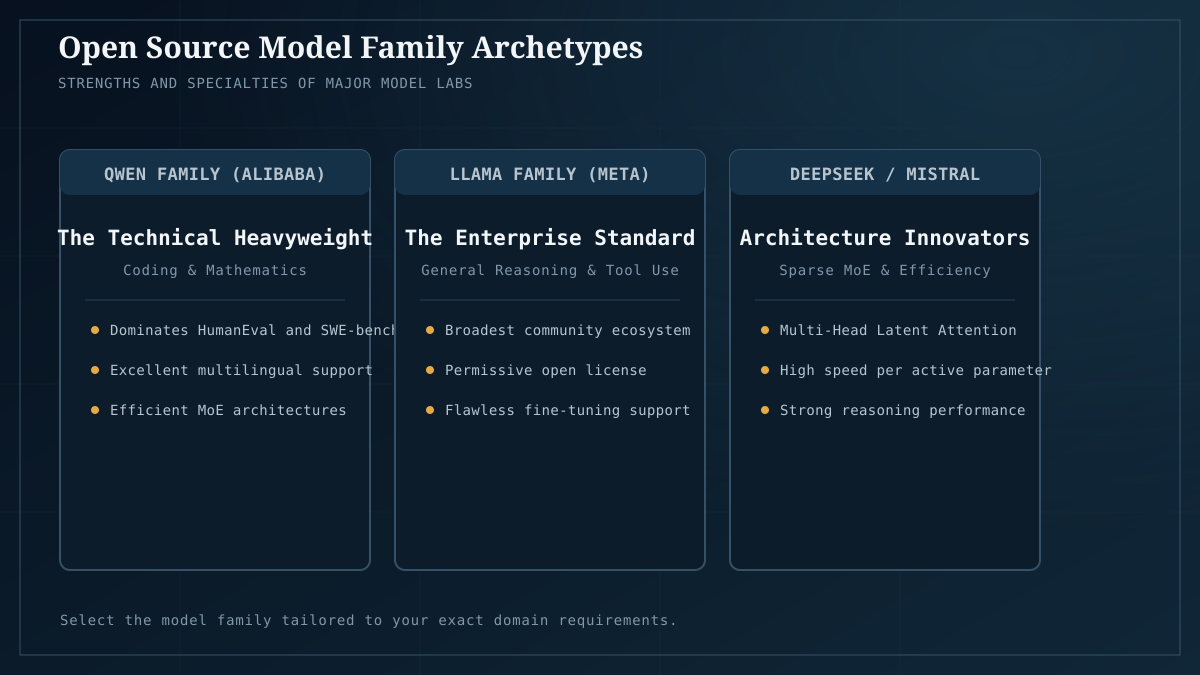
Narrowing to “what to download tonight,” assuming a typical reader with a 12–24GB card:
- You want a coding agent that runs on hardware you own: Qwen3-Coder-30B-A3B at Q4_K_M. It’s the default for a reason — see our 30B recipe and the private coding agent tutorial.
- You want fast, good-enough general chat / tool use: an 8B-class MoE like LFM2.5-8B-A1B. The tok/s on a 24GB card is genuinely real-time. Data: bm-007.
- You want maximum single-card quality and have 24GB: Gemma 3 27B or EXAONE 4.0 32B at Q4. Slower than the MoEs, smarter on hard questions.
- You’re on a laptop or a 1B-or-bust budget: Granite 4 1B or SmolLM3 3B. Yes, really. The small-model renaissance is real.
If none of those is enough — if you specifically need frontier reasoning — GLM-5.2 and Kimi K2.7 are excellent through an API. Run them there, run everything else here, and you’ve got the hybrid posture that’s actually honest.
Before you download anything, plug the model into Model Fit — it does the VRAM math so you don’t buy a card that can’t hold your target model. And if you want the numbers behind the recommendations above, the benchmarks are open.