We publish corrections when we’re wrong. This post is one of those, plus a real backend comparison that came out of it.
What has changed since we published
Updated 2026-09-13. This is a living reference, not a frozen verdict. OpenVINO Model Server 2026.3.0 was released after our original test; the releases page now also lists 2026.3.1. Our original measurement remains a dated record of the July 18 stack, not a claim about every later driver and runtime combination.
More importantly, a Mesa 26.1.7 report for a Battlemage Arc B580 found roughly doubled llama.cpp Vulkan decode throughput when moving from Mesa 26.0.8 to 26.1.7. It is a single external report, on a 12GB B580 and different models, not a replacement for our B60 result. But it makes the implication unavoidable: our 1.76x comparison was measured on the Mesa stack available on 2026-07-18, and a current Mesa stack may close much of that gap. We have not re-tested the B60 comparison yet; a same-model, current-stack re-test is queued.
What we used to say
For months, our internal fleet notes — and our earlier blog post on budget Arc builds — carried this warning:
“Use Vulkan, not SYCL. SYCL produces garbage output on Battlemage.”
That was based on a real observation: an ad-hoc llama.cpp SYCL build on our Arc Pro B60 produced broken output. We generalized it to “SYCL is broken on Battlemage, use Vulkan.” It made it into our benchmark records’ limitations sections. It sounded authoritative. It was also too absolute, and we should have tested the alternatives before publishing the claim.
What we actually tested this week
A reader pointed us at Intel’s OpenVINO Model Server (OVMS) — specifically the openvino/model_server:2026.2.1-gpu container, which is Intel’s curated serving stack for Arc Pro B-series hardware. We pulled it, loaded Intel’s own demo model (OpenVINO/Qwen3-30B-A3B-Instruct-2507-int4-ov), and pointed it at the same Arc Pro B60 we’d been running Vulkan on.
The result, in the OVMS startup log:
Available devices for Open VINO: CPU, GPU
...
state changed to: AVAILABLE after handling: ValidationPassedEvent
OpenVINO’s GPU plugin — which uses Level Zero, the same underlying Intel runtime that SYCL builds on — initialized cleanly on the Battlemage B60. No garbage output. No crashes. Validated and serving.
The difference: Intel’s container ships a matched oneAPI + Level Zero + NEO driver stack, version-pinned and tested together. Our ad-hoc SYCL build was almost certainly a driver/runtime version mismatch on a fresh architecture — a classic SYCL pitfall, not a Battlemage limitation. The fleet note was measuring our broken build, not the hardware’s capability.
The numbers: same B60, two backends
We ran the same 30B-A3B model class on the same Arc Pro B60 (Battlemage BMG G21, 24GB VRAM) under two backends:
| Backend | Model | Generation (tok/s) | Prompt processing (tok/s) |
|---|---|---|---|
| llama.cpp Vulkan (Mesa ANV) | Qwen3-Coder-30B-A3B Q4_K_M | 38.6 | 412.3 |
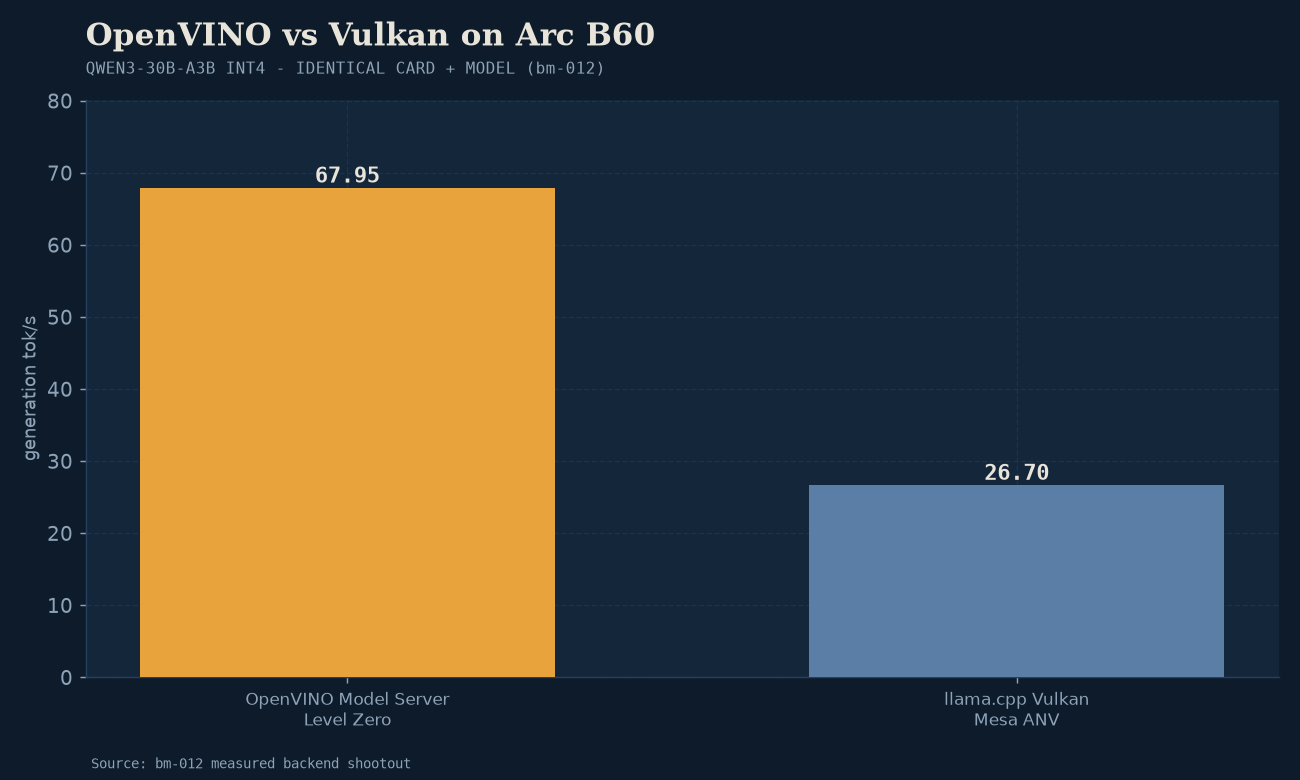
| OpenVINO/OVMS 2026.2.1 | Qwen3-30B-A3B-Instruct-2507 INT4 | 67.95 | ~630–1100 |
OpenVINO is roughly 1.76× faster on generation. Not a marginal win — a meaningful one. Full data in bm-012, with the Vulkan baseline in bm-001.
The honest caveats
The 1.76× is directional, not precise, because four things differ between those rows and we have to be honest about it:
- Measurement protocol. llama.cpp has
llama-bench— a purpose-built pp512/tg256 harness. OVMS has no equivalent, so we measured it via the OpenAI streaming API (time-to-first-chunk + generation rate from chunk counting). That’s an approximation, not a strict match. - Model variant. Instruct-2507 vs Coder. Same 30B-A3B MoE architecture, different weights.
- Quantization method. OpenVINO NNCF INT4 vs llama.cpp Q4_K_M are different INT4 schemes with different kernel implementations.
- Prompt length. Our OVMS prompt tokenized to 229 tokens, not the 512 llama-bench uses.
A same-model, GGUF-vs-IR comparison would tighten this, and it’s our documented follow-up. But the directional finding is clear: on Battlemage, OpenVINO is the faster path, and it works.
Reproduce it yourself
Pull the current 2026.3 GPU-line image, whose 2026.3-gpu tag is published on Docker Hub:
docker pull openvino/model_server:2026.3-gpu
Use an OpenVINO Hub model following the OpenVINO/...-int4-ov pattern, then compare your result with bm-012, which records the original B60 setup, numbers, and limitations. Do not treat a result from a different model, quantization, prompt length, or driver as a direct reproduction of the July result.
Why OpenVINO wins here
Two things likely contribute:
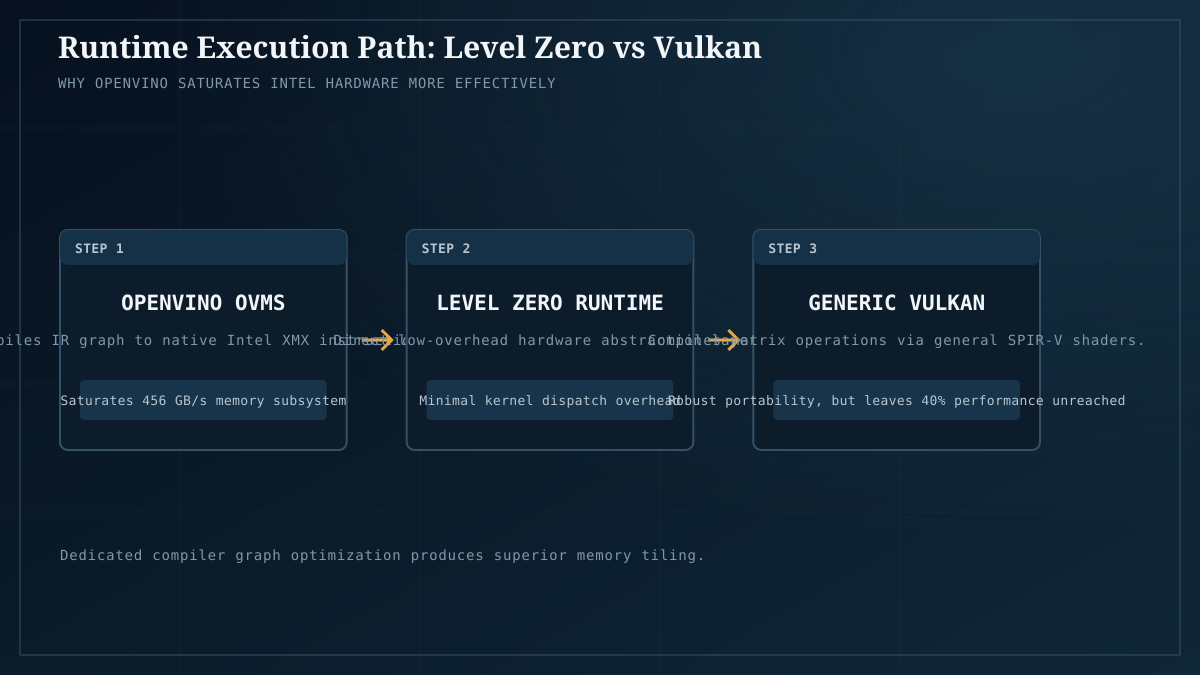
- INT4 KV cache compression. OpenVINO 2026.2 added INT4 KV cache for Intel GPUs, which cuts KV memory roughly in half vs INT8 and by two-thirds vs FP16. On long-context workloads, that’s both a memory and a throughput win.
- Compiled-model caching + continuous batching. OVMS is built for serving — prefix caching, paged attention, dynamic batching. llama.cpp Vulkan is fast at single-stream inference but doesn’t have the same serving-oriented optimizations.
If you’re running a single prompt at a time for personal use, the gap may be smaller. If you’re serving multiple agents from one B60, OVMS’s serving features compound with the raw speed.
What we changed
Three things, all in this session:
- New benchmark: bm-012 — the OpenVINO/OVMS measurement with full limitations documented.
- Softened the “Vulkan is the only working Battlemage path” limitation on bm-007 and bm-008. Vulkan is what we tested, not the only thing that works.
- Corrected our earlier blog post on budget Arc builds — the “SYCL produces garbage” line is gone, replaced with a pointer to this finding.
FAQ
Does this apply to the Arc B580 too?
Not as a B60 result. We tested the 24GB Arc Pro B60 in bm-012; the B580 has 12GB, and the Mesa 26.1.7 report is useful evidence that its Vulkan path improved, not evidence that OVMS has the same B60 advantage. The B580-versus-OVMS comparison has not yet been re-tested.
Should I use Vulkan or OpenVINO for a single user versus a server?
For a B60 serving workload, start from the documented bm-012 OVMS result; for a single-user setup, test the current Vulkan stack as well, because the newer-Mesa B580 report changes the prior tradeoff. We have not yet re-tested that choice on the B60.
Is the 1.76x result still true?
It is still the original July 18 measurement in bm-012, but it is not a current universal claim. The Mesa 26.1.7 B580 report means it needs a current B60 re-test; that re-test has not happened yet.
What about SYCL now?
Our earlier absolute SYCL warning was too broad, as this article’s original OVMS result established. We do not have a current independent SYCL-versus-Vulkan B60 retest; see the Battlemage retrospective for the historical context and treat current SYCL performance as not yet re-tested here.
Which quantization should I compare?
Use the original model and runtime setup if you are checking this article’s claim; quantization changes the comparison. The Qwen3-Coder quantization sweep supplies the separate Q4/Q6/Q8 context, but it is not an OVMS-versus-Vulkan re-test.
The takeaway
Two lessons, one for readers and one for us.
For readers with an Arc B60 (or considering one): OpenVINO Model Server remains worth testing. Pull the 2026.3-gpu container, grab a model from the OpenVINO/...-int4-ov collection, and compare it with your current Vulkan stack rather than assuming the July gap still applies. If you are weighing the B60 against other cards we have measured, our measured GPU buyer’s guide ranks the options by measured value.
For us: we should have tested before we generalized. “SYCL is broken on Battlemage” was a plausible-sounding conclusion from one broken build, and it sat in our docs for months. The fix wasn’t expensive — half a day of container-pulling and benchmarking. The lesson: when a claim about a platform’s capability rests on a single observation, that’s a prompt to test harder, not to publish.
Want the full backend comparison with all caveats? See bm-012. For the broader mid-2026 Arc picture after a year on the bench, see Battlemage one year in. For the separate Q4/Q6/Q8 context, see the quantization sweep. And if you want to check whether your target model fits the B60’s 24GB before buying, Model Fit has the math, and our VRAM guide explains the tier math. If you want the large-model story without a discrete card at all, see our mini-PC measurements.