For most of the local-AI era, “just buy NVIDIA” has been the safe advice, and “AMD works too” has been the brave advice. The question for 2026 is whether that’s still true — whether AMD Radeon is a genuine option or still the “it works, but…” alternative that costs you weekends in dependency hell. We can answer this from direct experience: two of our four lab machines are AMD (a Radeon RX 7900 XT 20GB and a pair of RDNA4 Radeon AI PRO R9700 32GB cards), and we benchmark them alongside NVIDIA and Intel Arc. The short version: AMD is a real option now, especially at the 24GB value tier, with one specific caveat that’s smaller than it used to be but hasn’t fully gone away.
This is the AMD counterpart to our cross-vendor GPU comparison — the focused deep-dive on what Radeon is actually like to live with.
The state of ROCm in 2026
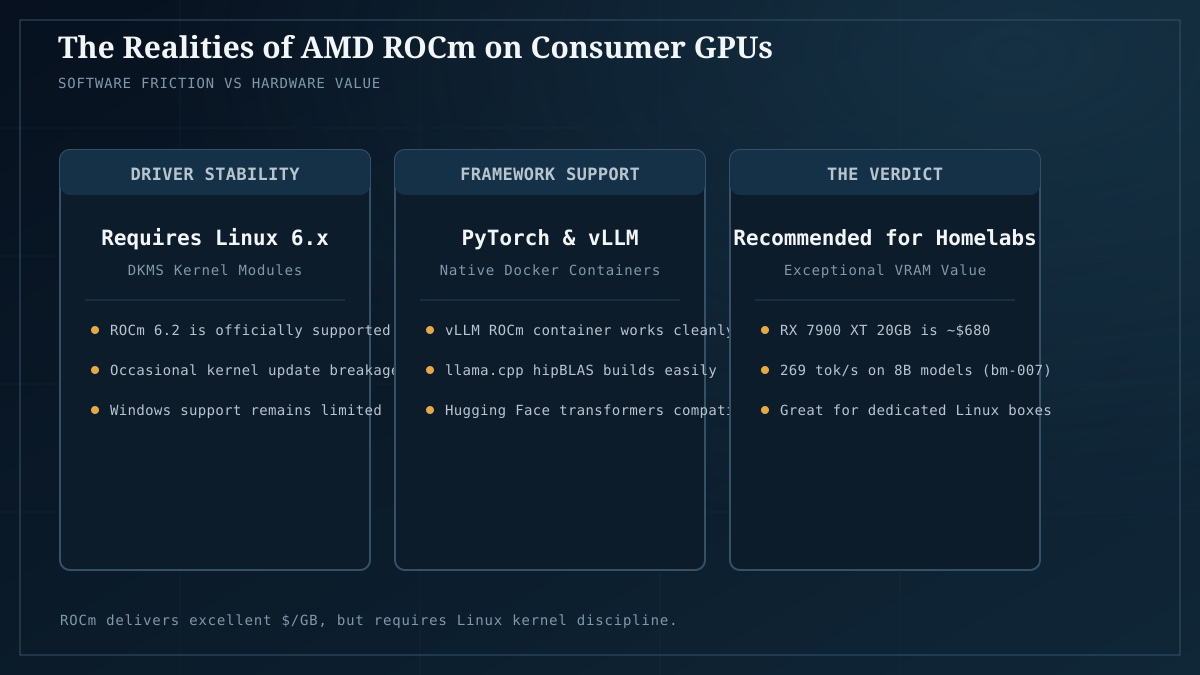
The software story is what made AMD painful, and it’s what’s improved most. As of ROCm 7.x — specifically 7.2 and later — the major local-LLM tools (Ollama, LM Studio, llama.cpp’s HIP backend, vLLM) reach roughly CUDA-comparable behavior on consumer Radeon without hand-patching builds. This is a real change from even a year ago, when getting llama.cpp onto a 7900 XTX often meant compiling custom HIP kernels and praying to the gfx version gods.
Concretely, on the consumer cards people actually buy:
- RDNA3 (gfx1100) — RX 7900 XTX / XT, RX 7800 XT, RX 7600 XT: officially supported since ROCm 5.7. This is the tier that “just works” with current Ollama and llama.cpp in 2026. The RX 7900 XTX is the card most people mean when they say “AMD for local AI” — 24GB VRAM, ~960 GB/s bandwidth, and community-measured ~96 tok/s on Llama 3.1 8B (roughly 75% of an RTX 4090’s throughput).
- RDNA4 (gfx1200 / Navi 48) — Radeon AI PRO R9700, RX 9070 XT: the newer generation. Our lab runs two 32GB R9700 cards (the Ray machine) on ROCm 7.0, and they work cleanly. Newer architecture, still bedding into ROCm; expect occasional rough edges on the very latest gfx targets but nothing like the old hand-compile era.
The honest caveat that remains: “works” is not “zero friction.” AMD users still report occasional driver friction — a weird crash after an update, a model that needs a flag NVIDIA doesn’t, a PyTorch nightly that lags its CUDA counterpart by days. It’s the difference between “plug and play” (NVIDIA/CUDA) and “plug, occasionally fiddle, play” (AMD/ROCm). If you want zero setup thought across every tool, NVIDIA is still the path of least resistance. If you’re willing to occasionally read an error message, AMD gets you there for materially less money at the 24GB tier.
Where AMD genuinely wins
Price-to-VRAM at the 24GB tier. This is AMD’s real argument. A Radeon RX 7900 XTX 24GB new is meaningfully cheaper than any new 24GB NVIDIA option, and it competes directly with the used RTX 3090 for the “cheapest 24GB” crown — except it arrives new, with a warranty, and with the modern features the 3090 lacks. For the VRAM-driven decision that defines local AI, that’s a serious value proposition.
Our measured experience. In bm-013 we ran the same Qwen3.6-27B model — byte-identical weights, verified by Ollama digest — across all four lab machines. The single-20GB RX 7900 XT generated at 25.21 tok/s, within 10% of the dual-NVIDIA machine’s 24.28 tok/s and the dual-32GB AMD machine’s 26.74 tok/s. The honest read: for a model that fits on one card, AMD’s single-20GB card kept pace with dual-GPU setups. That’s not “AMD is almost as good” framing — it’s “the single-card AMD rig is genuinely competitive on generation speed for models it can hold.”
24GB of bandwidth-backed VRAM. The 7900 XTX’s ~960 GB/s memory bandwidth is genuinely fast, and for autoregressive generation (which is memory-bandwidth-bound), that’s what determines tok/s. It’s why a 24GB Radeon card doesn’t feel like a compromise on generation speed despite the software overhead.
Where AMD still loses
Software ecosystem breadth. CUDA is the default compile target for essentially every ML project. When a new tool, a new attention kernel, or a new inference optimization ships, it ships CUDA-first. AMD follows — usually within weeks now, sometimes days — but NVIDIA users get it on day zero. If you’re the kind of person who lives on the bleeding edge of every new release, this lag is real. If you’re running mature tools (Ollama, llama.cpp, the established model files), you won’t notice.
PyTorch and training. We test inference, not training — that’s an explicit scope line. But if your work crosses into PyTorch training or fine-tuning, CUDA’s dominance there is even stronger than in inference. ROCm works for training in 2026, but the experience is rougher and the community troubleshooting material is thinner. For pure inference (our focus, and most readers’ focus), this matters less.
The “fiddle factor.” Summarized above, but it’s the honest recurring tax. Not a dealbreaker — clearly not, since we run AMD cards in the lab — but a real difference in day-to-day friction versus a CUDA rig that nearly always “just works.”
Vulkan as the AMD escape hatch
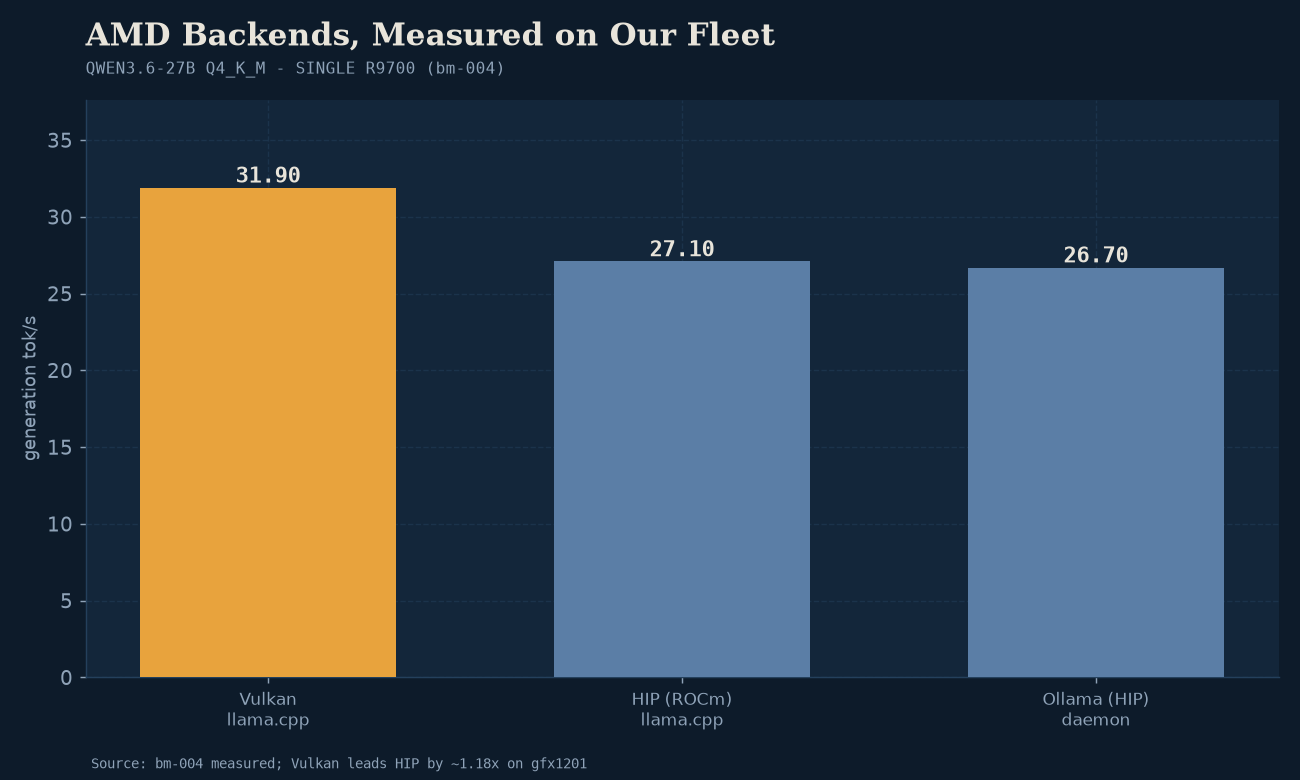
Here’s something worth knowing that simplifies the AMD story considerably: for llama.cpp specifically, the Vulkan backend is often more consistent than ROCm on AMD consumer cards, and it sidesteps the entire gfx-version question. Our lab runs AMD cards on Vulkan for exactly this reason — it’s the path of least resistance for inference across our RDNA3 and RDNA4 hardware. Our cross-backend comparison covers this in depth: Vulkan doesn’t match ROCm’s peak on workloads tuned for HIP, but it’s more portable and more predictable across AMD generations, which for a lot of users is the better trade.
If you buy a Radeon card for local AI and hit a ROCm wall, try Vulkan before you give up. It’s often the faster path to a working setup, and it’s first-class in llama.cpp now.
Who should buy AMD
- You want 24GB and price matters. The RX 7900 XTX is one of the two cheapest paths to a single-card 24GB tier (the other being a used 3090). If you want it new with a warranty, AMD is the value pick.
- You’re comfortable occasionally reading an error message. If “plug and play, never think about the stack” is your bar, pay the NVIDIA premium. If you’re fine with “plug, mostly play, occasionally fiddle,” AMD saves you real money.
- Your workload is inference, not training. For running models — our entire focus — AMD is genuinely competitive in 2026. For training/fine-tuning, the CUDA advantage is sharper.
Who should buy NVIDIA instead
- Zero-friction is non-negotiable. If your time is worth more than the price delta and you never want to think about your GPU stack, CUDA is still the path of least resistance. That’s worth real money.
- You’re on the bleeding edge of new tools/kernels. Day-zero CUDA support across the ecosystem is a genuine advantage if you live there.
- Training and fine-tuning are in scope. The CUDA dominance is strongest there.
The takeaway
Is AMD Radeon a real option for local AI in 2026? Yes — genuinely, not grudgingly, especially at the 24GB value tier. The software story has improved enough that “it works” is no longer followed by an exhausted ellipsis for most users, and the price-to-VRAM at the RX 7900 XTX is structurally attractive. The remaining caveats — occasional driver friction, ecosystem lag on bleeding-edge releases, and a rougher training story — are real but narrower than they’ve ever been, and for pure inference workloads they often don’t surface at all.
We run AMD cards in our lab alongside NVIDIA and Intel Arc specifically because the multi-vendor picture is more honest than any single-vendor recommendation. If you’re price-sensitive, want 24GB, and can tolerate the occasional fiddle, a Radeon card is a defensible primary choice in 2026 — not just a brave alternative.
Next: the cross-vendor GPU comparison puts AMD alongside NVIDIA and Intel Arc on measured workloads; the VRAM guide tells you whether you need 24GB at all; Builds has tested AMD part lists.
ROCm status reflects mid-2026 (ROCm 7.x). The software story improves steadily; re-check current tool compatibility for your specific card before buying. Sources: AMD ROCm compatibility matrix, r/LocalLLaMA 7900 XTX long-term review, llm-tracker.info AMD GPUs.